

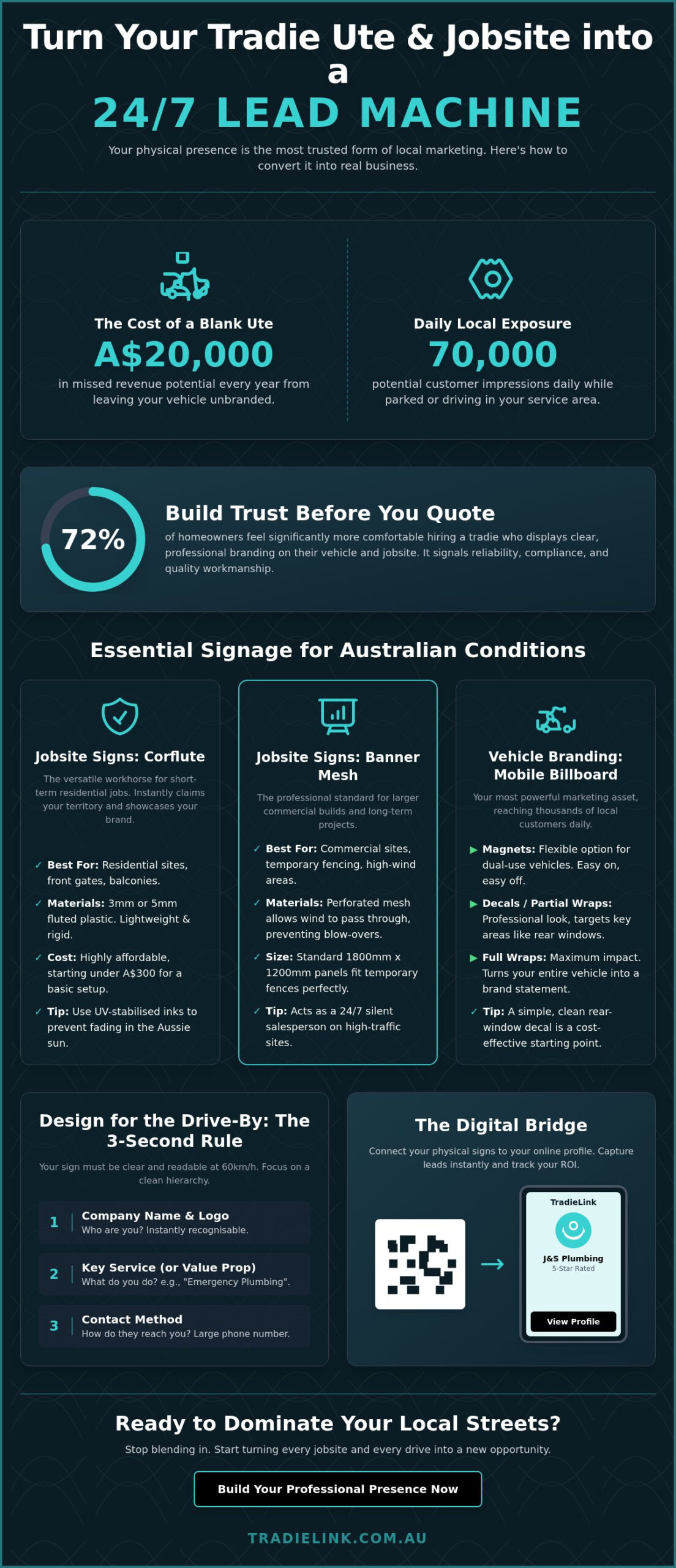
Your white ute is a A$20,000 missed opportunity every year you leave it blank. While you’re parked at the local supplier or sitting in traffic on the M1, you could be generating up to 70,000 impressions daily from potential customers in your local area. It’s frustrating to see competitors with half your experience win the big contracts just because they look more established on the road. You’ve likely felt the sting of wasting money on cheap signage that fades or curls after one month in the 40-degree Australian sun, making your business look temporary rather than top-tier.
We agree that your craftsmanship should be the main draw, but your visual presence must do the heavy lifting before you even step onto a site. You’re about to learn how to turn every jobsite and vehicle into a 24/7 lead generation machine with a professional branding strategy that works while you sleep. We’ll break down the specific 2026 material standards that survive the elements and the design layouts that make it easy for neighbours to grab your details. It’s time to stop blending in and start dominating your local streets.
Key Takeaways
- Understand why physical visibility remains the most trusted form of local marketing and how to turn every jobsite into a lead magnet.
- Identify the essential signage types built for harsh Australian conditions and why picking the right materials is a non-negotiable for your brand.
- Apply the 3-second rule to your designs to ensure your business is recognisable at 60km/h and leads know exactly how to contact you.
- Learn to track your marketing ROI by integrating QR codes that connect passers-by directly to your TradieLink profile.
- Optimise your lead generation by finding the strategic placement “sweet spot” on-site while staying on the right side of local council regulations.
What is Tradie Signage and Why Does it Matter in 2026?
For a modern Australian trade business, signage is no longer just a sticker on a truck door. It functions as a multi-channel branding tool that works 24 hours a day, 7 days a week. While digital ads are easy to scroll past, physical signage occupies real-world space in the communities where you work. The history and purpose of signage shows that visual communication is the oldest and most reliable way to signal a professional presence. In 2026, physical visibility remains the most trusted form of local marketing because it provides immediate proof of activity.
When you set up a branded jobsite, you create a psychological anchor for everyone in the street. Neighbors observe your punctuality, your gear, and your output. High-quality signage acts as a silent endorsement of your skills. It transforms a standard work site into a live demonstration of your brand’s standards. For tradies australia wide, this isn’t just about getting the next job; it’s about building long-term business equity. A 2024 industry report indicated that 72% of homeowners feel significantly more comfortable hiring a contractor who displays clear, professional branding on their vehicle and site equipment.
The Shift from Identity to Lead Generation
In 2026, your signs must do more than state your name. They need to convert passersby into active leads. This is the era of passive discovery. People walking the dog or driving to school notice your presence before they ever search for you online. If your signage only shows a logo and a mobile number, you’re missing out on high-intent traffic. Modern layouts focus on clear value propositions and easy contact methods like QR codes or simplified URLs. Moving beyond the basic approach means using your physical assets to answer the client’s first question: “Can this person solve my specific problem?” Pairing strong physical branding with websites for tradies built to convert local search traffic ensures you capture leads at every touchpoint, both on the street and online.
Building Trust Before the First Phone Call
Professional signage signals reliability and compliance to the public instantly. It suggests you’re a legitimate tax-paying entity with the right insurances and standards. This creates a “halo effect” where the cleanliness and quality of your signs reflect the quality of your workmanship. If your ute wraps are peeling or your site mesh is torn, potential clients assume your finishing work will be just as sloppy. Conversely, sharp branding allows you to justify premium pricing. You aren’t just another bloke with a ladder; you’re a structured business. This visual authority prevents you from having to compete solely on price against unbranded, fly-by-night operators.
Essential Signage Types for the Modern Australian Tradie
Choosing the right gear for the job is a rule every tradie lives by. Your signage shouldn’t be any different. In Australia, the sun is your biggest enemy. Cheap materials crack and fade under the intense UV radiation that often hits levels of 11+ during summer months. High-quality, UV-stabilised inks and heavy-duty substrates are non-negotiable if you want your brand to look professional for more than a single season. According to research on signage effectiveness, a single well-placed sign can generate up to 50% of a small business’s new customer base. For a new sole trader, starting with a basic corflute and a rear-window decal often costs less than A$300, providing an immediate professional edge without a massive upfront investment.
Jobsite Signs: Corflute and Mesh
Corflute is the bread and butter for residential sites. These 3mm or 5mm fluted plastic boards are lightweight and easy to zip-tie to a front gate or balcony. They’re perfect for short-term jobs where you want to claim your territory. For larger commercial builds, banner mesh is the standard. It features thousands of tiny holes that allow wind to pass through, which is critical for preventing temporary fencing from blowing over during 60km/h gusts. Most Australian suppliers provide these in standard 1800mm x 1200mm panels, designed to fit the dimensions of standard local temporary fencing perfectly. If you’re looking to grow your local presence, these signs act as a 24/7 silent salesperson while you’re busy on the tools. To get the most out of your corrugated plastic boards, understanding how to design and deploy corflute signs as a high-performance lead generation tool can dramatically improve the results you get from every site you work on.
Vehicle Branding: Magnets vs. Full Wraps
Your ute is a mobile billboard that reaches thousands of potential leads every day. Magnetic signs offer a flexible option for tradies who use their vehicle for family duties on the weekend. They’re easy to peel off, though they require regular cleaning to prevent paint damage. For maximum impact, a partial or full vinyl wrap is the gold standard. Industry data shows that vehicle wraps can garner up to 70,000 impressions per day in high-traffic metro areas like Sydney or Melbourne. If a full wrap isn’t in the budget, focus on the rear window. One-way vision decals are the highest visibility spot in Australian traffic, putting your phone number right at eye level for the driver stuck behind you in the morning rush. Complementing your vehicle wrap with custom stickers for your tools and equipment is one of the most cost-effective ways to extend your brand across every surface on site.
Portable Displays: A-Frames and Pull-Up Banners
A-frame signage is a portable, high-visibility tool for street-level marketing. These “sandwich boards” are essential for capturing foot traffic on suburban streets, especially for maintenance trades like plumbers or gardeners. They’re heavy enough to stay put in a breeze but light enough to toss in the back of the van at knock-off time. Pull-up banners are a different beast, designed primarily for indoor use. They’re a smart investment if you’re hitting local trade shows, community events, or shopping centre displays. They provide a clean, professional backdrop that tells your story in seconds. Stick to bold fonts and high-contrast colours to ensure your message hits home from 10 metres away.
Designing Signs That Actually Generate Phone Calls
Your signage is a 24/7 salesperson. Most tradies fail because they treat their van or site board like a business card. It’s not. It’s a high-speed billboard. Drivers traveling at 60km/h have roughly three seconds to digest your message before they’ve passed you. If they’re squinting to find your number or wondering what you actually do, you’ve already lost the lead. You need to strip away the fluff and focus on instant recognition.
Visual hierarchy determines what a customer sees first. Your service category must dominate the layout. While you’re proud of your business name, a potential client with a burst pipe is looking for the word “PLUMBER,” not “Smith & Sons Enterprises.” Use high-contrast colors to beat the harsh Australian sun. White text on a deep navy background or black text on safety yellow cuts through suburban glare and rural dust much better than muted earth tones or pastels. Avoid the clutter trap of listing every minor service you offer. Stick to your three primary money-makers to keep the design clean and professional.
The Core Information Checklist
- Service over name: Use bold labels like “Kitchen Renovations” or “24/7 Roof Repairs” as the largest element.
- Phone numbers win: For local trades, a phone number drives 70% more immediate action than a website URL. People want to talk to a human when they have a problem.
- Direct CTA: Don’t assume they know what to do. Include a clear “Call for a Quote” or “Book On-site Now” to trigger a response.
Typography and Readability Standards
Legibility is more important than branding. Choose clean Sans-serif fonts like Helvetica or Montserrat. These styles remain sharp at a distance, whereas Serif fonts often blur when viewed from a moving vehicle. Follow the 25mm rule: for every 10 meters of viewing distance, you need at least 25mm of letter height. If your site sign is 30 meters from the road, your main text needs to be at least 75mm tall to be readable.
Incorporate icons to bypass the need for reading altogether. A simple lightning bolt or a hammer icon communicates your trade in milliseconds. This visual shorthand allows you to keep text minimal, leaving more room for your contact details. Effective signage doesn’t just look good; it functions as a lead-generation tool that works while you’re busy on the tools. To ensure those leads find you online too, pairing your physical branding with a strong local seo for tradies strategy means you’ll dominate both the street and Google search results in your area.
The Digital Bridge: Connecting Signs to Your TradieLink Profile
Traditional signage often acts as a one-way street. You put up a fence mesh or a site board and hope someone remembers your name later. This lack of tracking makes it impossible to calculate your return on investment. Digital integration solves this by creating a direct path from the street to your digital storefront. Using technology like QR codes and NFC (Near Field Communication) turns every physical sign into a measurable marketing tool. For tradies who want to build a complete system around their physical branding, a dedicated marketing for tradies strategy ensures every impression your signage generates is captured and converted into booked jobs.
NFC technology is particularly effective for high-end residential work. It works like a digital “tap-to-call” feature. A potential client simply taps their smartphone against a small, weather-proof sticker on your site board. Their phone instantly opens your contact details or your booking page. It’s fast, professional, and removes the friction of typing in a phone number while walking the dog. By 2026, this level of connectivity will be the standard for any serious trade business in Australia. To make the most of this traffic, ensure you have one of the websites for tradies that are optimised to convert mobile visitors into booked jobs.
Implementing QR Codes Correctly
Success with QR codes depends on the details. If a code is too small or placed poorly, nobody will use it. Keep these three rules in mind to ensure your signage actually converts:
- Placement height: Position your codes at eye level, roughly 1.5 to 1.7 metres from the ground. This makes scanning natural and comfortable for passersby.
- Size for distance: A 10:1 ratio is a good rule of thumb. If the viewer is likely to be 2 metres away, the code should be at least 20cm wide to ensure the camera picks it up instantly.
- Dynamic tracking: Always use dynamic QR codes. These allow you to track exactly how many scans you get from a specific job site. You can also update the destination link without needing to reprint your boards if your website changes.
Using Your TradieLink Profile as a Landing Page
Sending traffic to a generic homepage is a common mistake. Most business websites are cluttered and hard to navigate on a mobile device. Your TradieLink profile is designed specifically for conversion. It acts as a high-performance landing page that showcases your verified 5-star reviews and a gallery of your best work right at the top where it matters.
This approach significantly reduces friction for the customer. Instead of searching for a contact form, the user can click one button to request a quote or book a consult. Data from 2024 shows that 68% of Australian consumers are more likely to engage with a service if they can see recent project photos and reviews immediately. Your profile works for you 24/7, capturing high-quality leads while you’re busy on the tools or off the clock.
Maximising ROI: Placement, Durability, and Compliance
Investing in signage only pays off if people actually see it and your brand stays looking sharp. A faded, peeling corflute sign suggests a business that cuts corners. To win more jobs in 2026, you need to treat your physical branding with the same precision you bring to a high-end renovation. It’s about being visible, staying legal, and protecting your professional image from the harsh Australian sun.
Strategic Jobsite Placement
Don’t just lean a sign against a pile of bricks. Effective placement targets the natural eye line of drivers and pedestrians, which usually sits between 1.5 and 1.7 metres from the ground. If you’re working on a residential street, position your main sign near the letterbox or the primary entrance where foot traffic peaks. Statistics show that 72% of locals notice branding on sites they pass daily, so making it readable from 10 metres away is vital.
- Secure it tight: Use heavy-duty, UV-rated cable ties to fix signs to temporary fencing. Loose signs that flap in the wind look amateur and risk causing property damage.
- Check the angles: Walk 20 metres up and down the street. If a parked ute or a bin obscures your logo, move it.
- Be a good neighbour: Never block a neighbour’s driveway or sightlines. A complaint to the council can result in a quick fine and a tarnished reputation before you’ve even finished the job.
Durability in the Australian Climate
The Australian sun destroys cheap prints in months. When ordering signage, specify UV-resistant latex inks and high-grade polymeric vinyl. These materials handle 40-degree days without bubbling. If you use site boards, ask for an anti-graffiti laminate. It adds a small upfront cost but allows you to wipe away spray paint or dirt with simple methylated spirits rather than replacing the whole unit.
Maintain your gear by cleaning it every 90 days. Use a soft cloth and mild soapy water. Avoid high-pressure washers, as they can lift the edges of vinyl lettering. Most high-quality wraps and boards have a lifespan of 3 to 5 years. If yours is cracking or the colours look washed out, retire it immediately. A “dodgy” sign tells potential clients that your standards have slipped. For a budget-friendly way to keep your branding fresh between major reprints, custom stickers designed for Australian conditions can patch up worn areas on toolboxes and equipment without breaking the bank.
Compliance and Insurance
Most Australian local councils allow temporary trade signs under 0.6 square metres without a formal permit, but rules vary between LGAs. Always check your local planning portal if you intend to leave a sign up for more than 14 days after a project ends. For vehicle wraps, you must notify your insurer. Most major Australian providers like NRMA or GIO view professional wraps as a modification. Failing to disclose this could lead to a rejected claim if you’re involved in a bingle, as the cost to replace custom graphics can exceed A$3,000 for a full van wrap. Once your branding is working hard on the street, pairing it with WorkflowMax software to manage every incoming job and track billable hours ensures no lead that comes through your signage ever slips through the cracks.
Take Control of Your Local Leads and Scale Your Trade
Effective signage in 2026 is the bridge between a busy job site and your next big contract. You’ve learned that high-visibility vehicle wraps and durable site boards aren’t just overheads; they’re active sales tools that work while you’re busy on the tools. Research into Australian transit media indicates that a single branded van can generate over 50,000 daily impressions in busy urban corridors. By focusing on clear contact points and professional design, you ensure your business stands out in a crowded local market.
Success on the road requires a strong digital backbone to catch the leads your signs generate. TradieLink is trusted by thousands of Australian tradies to provide that essential online presence. We help you seamlessly integrate your physical branding with a professional digital profile and Australia-wide directory placement. This connection makes it easy for locals to find your credentials and book a quote the moment they see your van. Don’t leave your growth to chance when you can build a system that delivers consistent results. Build your professional TradieLink profile and start winning more jobs today. It’s time to get your business noticed and keep the diary full.
Frequently Asked Questions
Do I need council permission to put a sign on my customers fence?
You don’t usually need council permission for a single temporary sign under 1 square metre on a customer’s fence. State regulations, like the NSW Exempt and Complying Development Codes, allow these as long as they’re non-illuminated. Always get the homeowner’s written consent first to avoid any legal headaches. If your sign stays up longer than 14 days after the job finishes, you could face a council fine.
How much does a basic set of corflute signs cost for a new tradie?
Expect to pay between A$150 and A$250 for a starter pack of 10 high-quality 5mm corflute signs. This price usually covers full-colour UV printing for a standard 600mm x 900mm size. Buying in bulk reduces your unit cost, often bringing it down to A$12 per sign for orders over 20 units. These are the most cost-effective signage options for new tradies building local brand awareness. For a complete breakdown of how to choose, design, and deploy your boards for maximum impact, the ultimate guide to corflute signs for Australian tradies covers everything you need to know before placing your next order.
What is the best material for outdoor signs in Australia?
Aluminium Composite Panel (ACP) is the best material for permanent outdoor signs in Australia. It resists warping even when temperatures hit 40 degrees in direct sun. ACP consists of a polyethylene core sandwiched between two thin aluminium sheets, lasting 5 to 7 years without fading. For temporary jobsite boards, 5mm fluted plastic is the standard choice because it’s lightweight and handles heavy rain without falling apart.
Can I use a QR code on my vehicle signage?
You should definitely use a QR code on your vehicle signage, but only on the rear panels or tailgate. Drivers can’t scan a code on a moving side door, but they can while you’re parked on-site or stopped at lights. Ensure the code is at least 150mm square so a phone camera reads it from 3 metres away. Link it to your TradieLink profile to track your leads instantly.
Should I put my prices on my jobsite signs?
Avoid putting specific prices on your jobsite signs. Material costs and job complexity change too often, and an outdated sign can lead to disputes with new leads. Instead, highlight your core services and a “Free Quote” call to action. Use 70% of the space for your brand and phone number. This keeps your message clear and ensures your sign remains relevant for 2 or 3 years.
How do I make my phone number stand out on a moving vehicle?
Use a bold, sans-serif font like Helvetica or Arial at a minimum height of 100mm for your phone number. High-contrast colour combinations, such as yellow text on a black background, increase readability by 40% compared to low-contrast options. Don’t crowd the number with other text. Give it at least 50mm of clear space around the digits so people can read it in the 3 seconds you drive past.
Is magnetic signage better than permanent vinyl decals for my ute?
Permanent vinyl decals are better for most tradies because they don’t fly off at 100km/h on the highway. Vinyl lasts up to 7 years and looks more professional than a thick magnet. Choose magnetic signs only if you use your ute for personal errands in a complex that bans commercial vehicles. Magnets require weekly cleaning underneath to prevent grit from scratching your paintwork and causing rust spots.
What is the most effective size for a jobsite corflute sign?
The 600mm x 900mm size is the industry standard for jobsite corflute signs because it fits perfectly on most residential fences. This size provides 0.54 square metres of space, which is large enough for your logo and phone number to be visible from 15 metres away. Anything smaller gets lost in the streetscape. Larger signs often require more robust mounting solutions to stop them from bending or blowing away. To round out your complete branding toolkit, pairing your jobsite signs with modern business cards for tradies that actually get kept ensures you have a professional contact solution ready for every on-site conversation.