

What if being “flat out” is the very thing stopping your business from actually growing? Many Aussie tradies mistake a packed schedule for success, but if you’re still competing with undercutting cowboys and losing nights to unpaid admin, you’re just spinning your wheels. Improving profitability for trade businesses in 2026 requires more than just grit. With inflation currently at 4.6% and the official cash rate at 4.35%, the margin for error has never been thinner.
You probably feel like a slave to the job site, watching high overheads and the 12% super guarantee eat your take-home pay. We agree that working harder shouldn’t mean earning less. This guide promises to move you beyond the “busy” trap by implementing high-margin strategies that attract quality leads who value reliability over the lowest quote. We will preview the 2026 action plan, covering everything from managing “payday super” regulations to using a professional TradieLink Profile and Lead Management System to get you off the tools and back to your family.
Key Takeaways
- Learn why high revenue doesn’t always equal high net profit and how to escape the “busy fool” trap for good.
- Master value-based quoting strategies that position your business as the premium choice without losing out on price.
- Discover how the 2026 tech stack, including NFC digital business cards, can slash your “admin tax” and reclaim lost hours.
- Implement a proven strategy for improving profitability for trade businesses by building digital authority to attract clients who don’t haggle.
- See how a Lead Management System and professional TradieLink Profile ensure every profitable opportunity is captured and converted.
The Profitability Gap: Why ‘Busy’ Doesn’t Mean ‘Profitable’
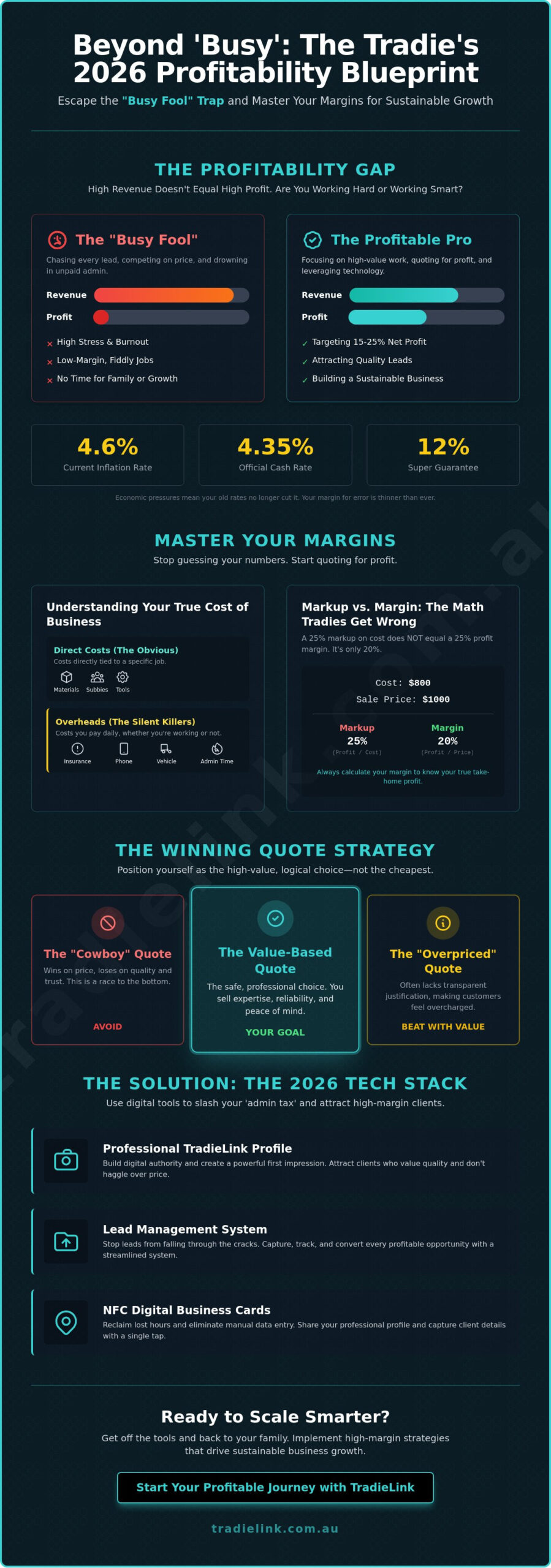
You’re flat out. The phone won’t stop ringing and your calendar is booked three weeks in advance. On the surface, it looks like you’re killing it. But if you’re checking your bank balance at the end of the month and wondering where the cash went, you’ve fallen into the profitability gap. High revenue is a vanity metric; net profit is the only number that actually keeps your doors open. Improving profitability for trade businesses starts with acknowledging that being a busy tradie is not the same as being a profitable business owner.
The ‘Busy Fool’ syndrome is a common trap in the Australian trade industry. It happens when you chase every lead, regardless of the margin. You take on the small, fiddly repair jobs that require three trips to the hardware store and four hours of unpaid travel. Your revenue goes up, but so do your fuel costs, vehicle wear, and stress levels. Eventually, the cost of servicing these low-value jobs exceeds the income they generate. You aren’t growing; you’re just accelerating toward burnout.
In 2026, the benchmarks have shifted. With inflation sitting at 4.6%, your old rates probably don’t cut it anymore. Successful trade businesses should aim for a net profit margin of 15% to 25% after paying themselves a fair market salary. If you’re hovering below 10%, you’re one major vehicle breakdown or one bad debt away from a crisis. For Brisbane-based tradies with European fleets, proactive maintenance through Eurotech Automotive can mitigate this risk. Identifying hidden profit killers, like unbilled travel time or material wastage, is the first step toward a healthier bottom line.
Understanding Your Profit Drivers
Profit isn’t just what’s left over. It’s a result of managing the tension between direct costs and overheads. Direct costs like materials and subbie labor are easy to track. Overheads are the silent killers. Your insurance, phone bills, and software subscriptions eat your margin every single day, whether you’re on a site or not. We focus on understanding your break-even point to ensure every hour on the tools is actually contributing to the bottom line.
Efficiency beats volume every time. Improving profitability for trade businesses often involves doing less, but doing it better. A 20% increase in job site efficiency through better organization and digital tools puts more money in your pocket than a 20% increase in total job volume. More volume usually just adds more stress and higher overheads without the reward.
The True Cost of Doing Business (CODB)
Most tradies underquote because they forget the “hidden” costs. You need to factor in vehicle maintenance, tool replacement, and the time spent on unpaid admin and quoting. If you don’t account for these, you’re essentially subsidizing your customers’ projects. Your True Cost of Doing Business is the minimum price of admission for any job. Every quote must cover this baseline before you even think about adding a profit margin. We want you to stop guessing and start knowing your numbers so you can build a sustainable future.
Mastering Your Margins: Quoting for Profit in a Competitive Market
Stop pricing your work based on what the guy down the road charges. If you quote solely to beat the local “cowboy,” you’re already losing. Improving profitability for trade businesses requires a shift from cost-plus pricing to value-based quoting. You aren’t just selling a bucket of parts and eight hours of labor. You’re selling expertise, safety, and a guaranteed result. Discounting is a race to the bottom that destroys your business equity. When you win on price alone, you’re training customers to value you only for your cheapness, not your craft.
Position yourself as the high-value “middle quote.” Most homeowners and commercial managers avoid the cheapest price because they fear a dodgy result. They avoid the most expensive because they don’t want to feel overcharged. By providing a professional, transparent breakdown, you become the safe, logical choice. Protecting your time is just as vital as protecting your rate. Implement a minimum call-out or diagnostic fee to filter out tyre-kickers. This ensures your specialized knowledge is respected from the moment you arrive on site.
Markup vs. Margin: The Math Tradies Get Wrong
Many business owners use these terms interchangeably, but doing so is a dangerous mistake. If you want a 20% profit in your pocket at the end of a project, simply adding a 20% markup to your costs won’t get you there. You need to build profitability into your business by mastering the actual math of your take-home pay.
| Goal | Job Cost | Sale Price | Actual Margin |
|---|---|---|---|
| 20% Markup | $1,000 | $1,200 | 16.6% |
| 20% Margin | $1,000 | $1,250 | 20% |
Always include a contingency buffer in your quotes. Unexpected site issues or material price hikes shouldn’t come out of your pocket. A 5% to 10% buffer ensures a small complication doesn’t turn a profitable job into a break-even project. Calculate your breakeven point for every project before you send the quote to ensure your overheads are fully covered.
Streamlining the Quote-to-Cash Cycle
Speed is a massive competitive advantage in 2026. The first tradie to deliver a professional quote often wins the contract because they demonstrate reliability. Use templates and standardized pricing lists to eliminate the quoting fatigue that kills your evenings. It’s a proven fact that professional tradie websites build trust before the quote is even opened, making your pricing more acceptable to the client. Managing your pipeline shouldn’t feel like a second job. Our Lead Management System helps you track every opportunity from the first click to the final invoice.
Reclaiming the ‘Admin Tax’: Efficiency Through Digital Tools
Every hour you spend manually typing phone numbers into a spreadsheet or chasing a signature is an hour you aren’t earning. We call this the ‘Admin Tax.’ It’s the silent drain on your bottom line that keeps you working long after the sun goes down. Improving profitability for trade businesses isn’t just about what happens on the tools; it’s about what happens in the gaps between jobs. While the Australian Government’s guide to starting a business covers the legal basics of tax and budgeting, modern tradies need a 2026 tech stack to stop the leakage of billable time.
The goal is to reduce friction. You want to make it stupidly easy for customers to book you and even easier for them to pay you. If your process involves three phone calls and a paper invoice sent a week late, you’re inviting delays and lost revenue. Centralizing your operations through a digital profile and a dedicated Lead Management System ensures no profitable opportunity falls through the cracks. You need a workflow that moves as fast as you do on a job site.
NFC and Digital Business Cards: The Instant Lead Capture
Paper cards are a relic. Most end up in the bin or the bottom of a glove box within ten minutes of being handed over. Modern business cards have evolved into high-tech lead capture tools. With an NFC Digital Business Card, one tap against a client’s phone instantly populates your CRM and job pipeline. It’s about professional first impressions and immediate action. By integrating your digital card with your professional TradieLink Profile, you provide instant social proof, reviews, and contact details without the client having to type a single word.
Job Management and Workflow Efficiency
Knowing your numbers is impossible if they’re scattered across notebooks and text threads. You need real-time tracking to know if a job is profitable before it’s even finished. High-performing teams use tools like workflowmax software to track job-level profitability and monitor billable versus non-billable hours. This level of visibility allows you to spot where you’re losing money on specific tasks and adjust your quoting accordingly.
Automation is your best employee. It doesn’t take sick days and it never forgets a follow-up. By automating the boring stuff—like invoicing, appointment reminders, and review requests—you reclaim hours of your life every week. Improving profitability for trade businesses means using these tools to handle the heavy lifting of business administration, leaving you free to focus on your craft and your family.
Attracting High-Margin Work: Positioning Your Brand Above the Price War
Stop fighting for crumbs. Improving profitability for trade businesses relies on a strategic shift from ‘any job’ to ‘the right job.’ When you compete on price, you’re fighting a losing battle against guys with no overheads and nothing to lose. Instead, build digital authority. Your online presence acts as a 24/7 sales team that qualifies leads before you even pick up the phone. A professional image tells the market you’re an expert, not just another pair of hands.
Dominate your local area by winning the ‘near me’ search. Investing in local SEO for tradies ensures you appear exactly when high-intent customers are ready to book. Reinforce this digital trust with high-impact physical signage. A clean, branded van and professional job site boards connect your offline presence to your online reputation. This creates a loop of visibility that makes your business feel established and reliable.
Filtering for Quality Leads
Your website should be a gatekeeper. Use it to pre-qualify leads by clearly stating your process, your minimum job size, and the specific types of projects you take. Don’t be afraid to scare off the price-shoppers; they’re the ones who will eat your time and complain about the invoice later. Specialized work consistently pays better. ‘The Bathroom Specialist’ can always command a higher rate than a general ‘Plumber’ because they own a specific niche in the customer’s mind.
Effective marketing for tradies must focus on solving client pain points like reliability, cleanliness, and communication. This focus is a core pillar of improving profitability for trade businesses because it attracts clients who value quality and certainty over the lowest quote. When your marketing speaks to their problems, price becomes a secondary conversation. You’re no longer a commodity; you’re the solution they’ve been looking for.
Social Proof as a Profit Driver
Trust is a bankable asset. There is a direct link between a consistent stream of 5-star Google reviews and your ability to charge premium rates. Customers pay for peace of mind, and they use the experiences of others to gauge your worth. Don’t just collect reviews; showcase them in your quotes and on your social profiles to build immediate credibility. For those targeting commercial contracts, a professional Capability Statement is the tool that wins larger, more profitable work by proving you have the systems to handle the load.
Brand equity is the premium a customer pays for certainty. It’s the reason they’ll choose you over a cheaper alternative they found on a random community board. By centralizing your reputation and making it visible, you reduce the perceived risk for the client. Build your professional TradieLink Profile today to start attracting the high-margin clients your business deserves.
Scaling Smarter: How TradieLink Drives Sustainable Business Growth
Scaling a trade business isn’t about hiring more people; it’s about building a system that works while you’re asleep. Improving profitability for trade businesses requires a central hub where your reputation, leads, and marketing collide. A TradieLink Profile gives you that hub. It centralizes your digital presence so you don’t have to manage five different platforms just to get a single job booked. When your profile, website, and lead management work together, you stop losing money to disorganization.
Our Lead Management System is designed to stop profitable opportunities from falling through the cracks. Most tradies lose thousands every year simply because they forgot to follow up on a text or an email. We fix that. By funneling every inquiry into one dashboard, you can see exactly which jobs are worth your time. This is essential for tradies Australia wide who want to move from being ‘flat out’ to being highly profitable. You gain the clarity needed to choose high-margin work over low-value time-wasters.
Your 24/7 Digital Salesman
Your profile is your 24/7 digital salesman. It builds trust with potential clients by showcasing your reviews and capability statements before you ever set foot on their property. When you tap your NFC Digital Business Card, you aren’t just giving them a phone number; you’re giving them a gateway to your professional brand. This seamless integration ensures your networking efforts lead directly to your digital storefront. You can track performance metrics to see exactly where your best leads are coming from, allowing you to double down on what works and cut what doesn’t.
Taking the Next Step Toward Profit
Stop guessing your numbers. Improving profitability for trade businesses is a management task, not a luck-based one. You’ve seen the 2026 roadmap. You know how the ‘Admin Tax’ and ‘Busy Fool’ syndrome eat your bottom line. Now it’s time to act. Setting up your profile is fast and lets you reclaim the hours you currently lose to manual admin and chasing dead-end leads. Join a community of profit-focused professionals who value their time as much as their craft. Join TradieLink and start building a more profitable business today.
Take Control of Your Business Growth in 2026
You’ve seen the roadmap to a more sustainable future. Improving profitability for trade businesses isn’t about working more hours or chasing every lead that hits your inbox. It’s about closing the gap between being flat out and being truly profitable. You’ve learned how to master your margins, kill the admin tax, and position your brand to attract clients who value your expertise over a cheap quote. The difference between a struggling trade and a thriving business is the system you put in place today.
The tools you use define the ceiling of your success. You don’t have to manage this shift alone. With NFC-enabled digital business cards, custom-built websites for trade professionals, and advanced lead management to track your ROI, you can stop guessing and start growing. It’s time to step up and claim the profit your hard work deserves. We’re ready to help you build a business that empowers your lifestyle instead of consuming it.
Build Your Professional TradieLink Profile Today and turn your trade into a high-margin legacy. You’ve got the skills; now get the systems to match.
Frequently Asked Questions
What is a good profit margin for a trade business in Australia?
A healthy net profit margin for an Australian trade business typically sits between 15% and 25% after you’ve paid yourself a fair market wage. If your margin is below 10%, your business is vulnerable to economic shifts or unexpected equipment failure. Achieving this range requires careful management of the 12% superannuation guarantee and rising overheads. Knowing your exact numbers is the only way to stay ahead of the pack.
How can I increase my prices without losing all my customers?
Increase your prices by shifting the conversation from cost to value and professional reliability. Transparently explain that rising inflation, currently at 4.6%, and material costs necessitate a rate adjustment to maintain your high service standards. Most quality clients will accept a fair increase if they trust your expertise and punctuality. Use professional digital profiles and social proof to justify your premium positioning before you even send the quote.
Is it better to focus on more leads or better quality leads?
Focusing on quality leads is the most effective strategy for improving profitability for trade businesses. Chasing every low-value inquiry leads to “quoting fatigue” and wasted fuel. High-quality leads are customers who value certainty and are willing to pay a premium for specialized work. By filtering for the right jobs, you reduce your unpaid admin time and increase the actual take-home pay from every hour spent on site.
How much time should a tradie spend on admin vs. on the tools?
Try to cap your administrative tasks at 10% of your total working hours. If you’re spending 20% or more of your week on invoicing and callbacks, you’re losing billable time or sacrificing your personal life. Digital tools and lead management systems are designed to handle the heavy lifting of business operations. Automating these repetitive tasks keeps you on the tools where you’re actually making money.
What are the most common hidden costs in a trade business?
Unbilled travel time, vehicle depreciation, and the “admin tax” of manual data entry are the most frequent profit killers. You must also account for the legislated 12% superannuation rate and prepare for “payday super” regulations starting July 1, 2026. If your quotes don’t factor in these operational realities, you’re essentially subsidizing your clients’ projects out of your own pocket. Every small, uncharged expense adds up over a financial year.
Can digital business cards really help improve my profitability?
Digital business cards boost profitability by slashing the time you spend on manual lead entry and reducing the “bin rate” of paper cards. One tap of an NFC card instantly captures client details into your lead management system. This speed ensures you follow up while the lead is still hot. It creates a professional first impression that sets you apart from competitors who are still scribbling notes on scrap paper.
Do I need a website if I already have plenty of word-of-mouth work?
A website is vital for improving profitability for trade businesses because it pre-qualifies those word-of-mouth referrals. Even referred customers will search for you online to verify your reviews and capability. A professional site allows you to showcase your niche specialization and filter out “tyre-kickers” who only care about the lowest price. It transforms your business from a local secret into a high-authority brand that commands higher rates.
How does job management software actually save me money?
It saves money by spotting “leakage” in your billable hours and ensuring every material cost is invoiced correctly. Real-time tracking allows you to see if a project is profitable before it’s finished. You can catch budget blowouts early and adjust your workflow. It also speeds up your quote-to-cash cycle, meaning you get paid faster and spend less time chasing late invoices at the end of a long day.