

If you’re still handing out paper business cards in 2026, you’re likely watching your hard-earned profit end up in the bin or the bottom of a dusty ute tray. A 2024 industry report confirms that 88% of paper cards are thrown away within one week of being handed over. It’s a massive waste of time and resources for any busy sparky, plumber, or chippy trying to grow their business.
We know the drill. You hand a lead your card, they shove it in a pocket, and by the time they’re ready to book, it’s a crumpled mess or gone for good. It’s frustrating to pay for constant reorders only to have your contact info vanish before the quote is even signed. You need a professional way to share details that actually sticks, even on a high-pressure job site.
This guide explains why traditional cards are failing on-site and how modern NFC technology is changing the way Australian tradies win work. We’ll compare the most durable solutions for 2026 and show you how to build a digital system that tracks every lead you meet, ensuring you never lose a job to a lost scrap of paper again.
Key Takeaways
- Stop losing leads to the “junk drawer” by understanding why traditional handshakes need a digital backup on the Aussie job site.
- Compare the durability and conversion rates of traditional paper vs. modern NFC business cards to choose the best tool for your ute.
- Learn how to use QR codes and social proof to turn a simple contact exchange into a direct link to your professional TradieLink profile.
- Discover the heavy-duty materials that survive the Australian climate and keep your business details legible in a hot glovebox.
- Streamline your admin and win more work by integrating your physical networking with an all-in-one digital lead management system.
Why Business Cards Still Rule the Job Site in 2026
In 2026, the Australian trade industry remains a contact sport. While digital tools have changed how we manage projects, the physical handshake still seals the deal on the driveway. When you’re standing on-site, a digital-only approach often falls flat. Fumbling with a phone to find a QR code while your hands are covered in dust breaks the flow of a professional quote. Physical business cards bridge that gap immediately. They provide a tactile reminder of your expertise that sits on a kitchen bench rather than getting lost in a sea of phone notifications.
The psychological impact of a physical handout is backed by hard data. A 2024 study by the Marketing Research Association found that 72% of people judge a company’s quality based on the feel and finish of their card. For an Australian tradie, this isn’t just about contact info; it’s about lead retention. Statistics show that homeowners are 28% more likely to call back a contractor who left a physical prompt compared to one who only sent a text or email. This physical presence keeps your brand top-of-mind when the client is finally ready to hit “accept” on that A$5,000 renovation quote.
The Evolution of the Tradie Handout
The trade industry has moved far beyond the basic black-and-white printouts of the past. Looking back at the history of business cards, they have always served as a marker of professional status. Today, the “Tradie” brand is more competitive than ever. We’ve seen a massive shift from simple contact details to a full brand experience delivered in 30 seconds. Modern business cards now feature NFC chips, textured “grit” finishes that mimic building materials, and direct links to live portfolios. This evolution reflects a broader trend: Australian tradies are no longer just workers; they’re sophisticated business owners who use every tool to win the job.
First Impressions and Credibility
In a market where trust is everything, a professional card separates the licensed pros from the “cowboys.” Handing over a flimsy, poorly designed card tells the client you might cut corners on their bathroom tiling or electrical switchboard too. Conversely, a high-quality, weighted card justifies a higher quote price through perceived value. If you look like a premium service, you can charge like one. This is especially true in the commercial sector, where site managers and developers expect a level of polish that matches their own corporate standards. For example, just as professional suit alterations Brisbane CBD help a business owner look the part at a high-stakes tender meeting, your business card must reflect that same commitment to quality. Building a local reputation starts with that first exchange; make sure it carries the weight of your actual skills.
Paper vs. NFC Digital Business Cards: Which Wins for Tradies?
The Australian trade industry relies on quick connections. You meet a homeowner on a job site or chat with a site manager at a local wholesaler. In those moments, your professional identity needs to land firmly in their hands or their phone. While business cards have been the standard for decades, the choice between traditional paper and modern NFC technology now defines how efficiently you capture leads.
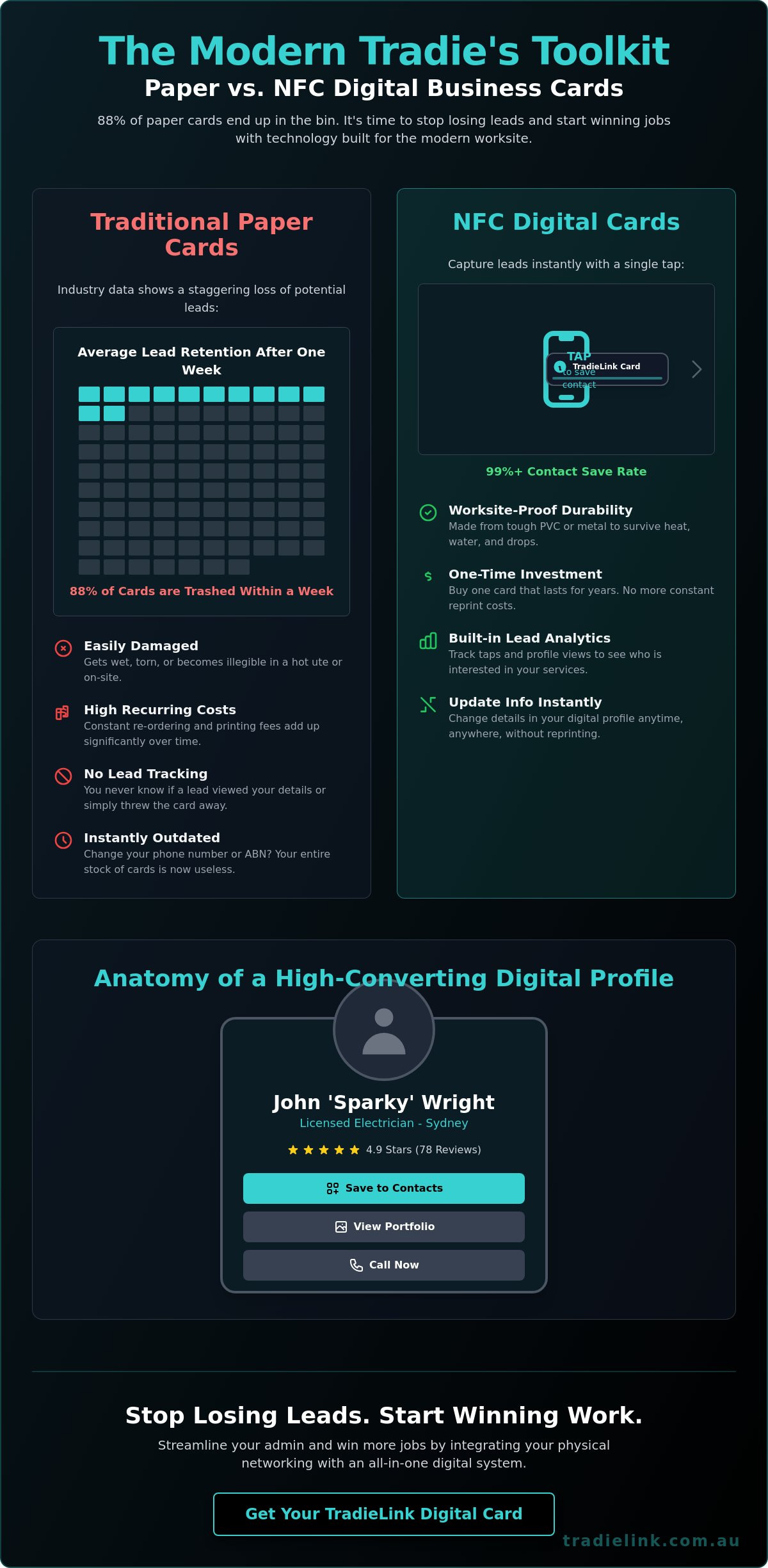
Data suggests that 88% of paper cards are thrown away within less than a week. For a plumber or sparkie, that is literal money in the bin. A paper card often ends up in a junk drawer or the bottom of a tool bag, becoming illegible or lost. NFC cards solve this by moving your contact details directly into a client’s smartphone contacts with a single tap. This eliminates the “lost lead” factor entirely. If you want a deeper dive into how NFC-enabled digital cards of business capture lead data instantly and turn every tap into a permanent connection, our dedicated guide covers the full technology breakdown.
The Pros and Cons of Traditional Printing
Traditional business cards printing remains a popular choice for bulk outreach. If you’re doing letterbox drops in a new housing estate in Western Sydney or Melbourne’s outer suburbs, paper is the only way to go. It has a low entry cost, often starting around A$50 for a basic batch. However, the recurring expenses add up quickly. Paper cards get dog-eared, wet, or outdated the moment you change your mobile number. They are tactile and familiar, but they lack the tracking capabilities required for modern marketing and sales strategies that help you beat the local competition.
The Rise of the NFC Digital Card
NFC (Near Field Communication) technology is now the standard for mobile connectivity. Most smartphones manufactured after 2018 have this tech built-in. You don’t need a special app; you just tap your card against the client’s phone. This instantly triggers a prompt to save your contact info, including your name, ABN, and a link to your reviews. You can update your services or phone number in real-time through an online dashboard without spending another cent on business cards. It’s a professional move that shows you’re tech-savvy and organized.
ROI Analysis: Cost Over 3 Years
- Premium Paper Cards: A$150 for 1,000 cards. If you hand out 300 a year and account for reprints due to detail changes, you’ll spend roughly A$450 over three years.
- NFC Digital Card: One-time hardware cost of approximately A$60 to A$90. Even with a small annual profile subscription, the three-year cost stays under A$200.
- Lead Conversion: A single won job, such as a full switchboard upgrade or a bathroom rough-in, can be worth A$3,000 to A$10,000. If an NFC card saves just one lead that a paper card would have lost, the ROI is over 1,000%.
Investing in the right tools helps you grow your tradie business by ensuring every handshake turns into a saved contact. While paper cards represent a recurring leak in your marketing budget, a single NFC card offers a permanent digital handshake that pays for itself the moment it prevents one lost lead from ending up in a bin. For a real-world example of this in action, see how one Aussie sparky scaled their business using a streamlined digital pipeline to win high-value commercial leads in 2026.
Essential Elements of a High-Converting Tradie Business Card
Your business card isn’t just a scrap of paper to hand over at the end of a quote. It’s a silent salesman that keeps working long after you’ve left the job site. In 2026, roughly 80% of physical cards are discarded within a week. To ensure yours stays in a client’s wallet or gets saved to their digital contacts, it must move beyond just a name and a mobile number. High-converting business cards act as a bridge between a face-to-face meeting and a booked job.
Visual hierarchy is the most critical design factor. Your primary service, such as “Emergency Plumbing” or “Split System Specialist,” should be the most prominent text on the card. Most clients won’t remember your name, but they will remember the trade they need. Following professional business card tips for networking helps you balance these design elements without cluttering the limited space. Every card needs a clear Call to Action (CTA). Don’t just list your details; tell the customer what to do. Use phrases like “Scan for an Instant Quote” or “Call for 24/7 Emergency Response” to drive immediate action.
Critical Contact Information
Trust is the primary currency in the Australian trades industry. You can build this instantly by including your ABN and state-specific license numbers on your card. These trust-builders prove you aren’t a cowboy and that you’re fully insured for the work. Adding a professional photo of yourself in your uniform is another powerful tactic. It reminds the client exactly who you are when they find your card in a kitchen drawer months later. To streamline your lead flow, include a direct link to your tradies australia profile. This allows potential customers to view your verified reviews and past project photos with a single tap.
Leveraging Modern Technology
Static cards are a thing of the past. In 2026, every card should feature a QR code that is at least 2cm square to ensure it scans reliably on a dimly lit job site. This code should point to a dedicated tradie website rather than a social media page. A website allows you to capture lead data and track exactly where your customers are coming from.
Smart tradies now use dynamic links for their business cards. This technology lets you change the destination of your QR code without needing to reprint your physical stock. You can point the link to a “Winter Heating Special” in June and switch it to “Solar Panel Cleaning” by October. This flexibility ensures your marketing remains relevant to the current season, maximising your return on every card handed out. Pairing this approach with a broader marketing for tradies strategy ensures your physical and digital efforts work together to keep your pipeline full of high-quality local jobs.
Designing for Durability: Surviving the Aussie Job Site
A standard business card lasts about three days in a tradie’s pocket before it looks like a piece of wet tissue paper. Between the 40-degree heat in the ute and the constant dust on-site, your branding takes a beating. If a potential client pulls a dog-eared, faded card out of their wallet, they won’t see a professional; they’ll see someone who cuts corners. In the Australian climate, your physical business cards must be as rugged as your tools.
Material Science for Tradesmen
Standard 350gsm paper is the industry floor, but it’s not enough for the field. It absorbs moisture and creases instantly. You need at least 450gsm cardstock finished with a matt or velvet lamination. This coating acts as a barrier against grease and light rain. For plumbers and landscapers who deal with water daily, PVC cards are the smart play. They’re 100% waterproof and virtually indestructible. If you’re a high-end builder or specialized contractor, metal business cards made from stainless steel or anodised aluminium create an immediate sense of permanence. They don’t just survive the job site; they dominate the conversation.
Digital Durability and Reliability
Modern NFC cards bring tech to the trenches, but they need to be rugged. Cheap chips fail after a few taps or crack under pressure. Choose cards with embedded NTAG213 or NTAG215 chips protected by a thick PVC or polycarbonate layer. This ensures the tech keeps working even if the card gets dropped in the mud. Always include a laser-etched QR code on the back. It’s your fail-safe. If a client has an older phone or the NFC sensor is blocked by a heavy-duty case, the QR code ensures they still get your details. Keep your digital profile updated. A broken link is just as useless as a torn paper card.
Stop throwing your cards in the glovebox loose. Heat cycles in a locked vehicle can reach 70°C, causing laminates to peel and ink to bleed. Use a dedicated hard-shell case or a visor clip to keep your cards pristine until the moment of exchange. Your card is your handshake when you aren’t there. Make sure it stays sharp and professional, regardless of the conditions on the ground.
Ready to upgrade your professional image? Build your digital profile with TradieLink today.
Leveling Up with TradieLink: The All-in-One Digital Card Solution
Traditional business cards often die in the back of a ute or at the bottom of a client’s junk drawer. TradieLink changes that by bridging the gap between a physical handshake and a high-performance lead management system. We’ve built a solution that combines the tactile feel of a premium NFC card with a digital profile designed to convert. It’s about working smarter, not harder, on your admin.
When you tap your TradieLink card on a customer’s phone, you aren’t just giving them your number. You’re positioning your business as a modern, tech-savvy leader in your local market. It shows you’re organized and ready to handle their project with the same precision you use on-site. This digital ecosystem ensures no lead falls through the cracks, giving you a massive edge over competitors still relying on pens and scraps of paper.
Seamless Lead Management
Admin shouldn’t eat into your downtime. With TradieLink, a single tap drops a lead directly into your dashboard. This eliminates the 15 minutes you usually spend every night squinting at crumpled cards to type phone numbers into your contacts. It’s clean, fast, and professional. Consider these benefits for your daily workflow:
- Instant Data Entry: Client details sync to your TradieLink dashboard the moment they interact with your profile.
- Automated Follow-ups: Set up the system to send an immediate “nice to meet you” text or email. This keeps your brand top-of-mind while you’re still on the job site.
- Lead Tracking: Know exactly where your leads are coming from and which jobs are worth your time.
Building Your Digital Presence
Your physical card is only as effective as the destination it links to. A TradieLink profile acts as your digital storefront, showcasing your best work and verified credentials instantly. By integrating your local seo for tradies strategy with your physical networking, you create a powerhouse marketing loop. When you meet a local builder or homeowner, your profile reinforces your authority in the specific area you serve.
Closing the loop is the final step in the TradieLink ecosystem. Once a job is done, your digital connection makes it easy to prompt a Google Review with a single click. Research shows that 88% of consumers trust online reviews as much as personal recommendations. By making the transition from a handshake to a five-star rating seamless, you build a reputation that wins work while you sleep. Stop handing out business cards that lead nowhere and start building a connected business that grows itself.
Build a Smarter Trade Business Today
The Australian job site is no place for flimsy paper. By 2026, the standard for professional branding has shifted from pockets full of lint-covered cardboard to durable, high-tech tools. You’ve seen how NFC technology eliminates the friction of manual data entry and ensures your details land straight in a client’s phone every time. It isn’t just about looking sharp; it’s about making sure the next quote request comes to you instead of the competition.
Thousands of Australian tradies already use our NFC-enabled hardware to streamline their networking and secure more work. These tools work as hard as you do, surviving dust and drops while providing an integrated lead management dashboard to track every connection. Don’t let another potential job slip through the cracks because of a lost scrap of paper. Your business cards should be assets that work for you, not chores you have to manage.
Upgrade to a TradieLink NFC Digital Business Card and stop losing leads today.
It’s time to get back to what you do best with the right tech in your pocket. Let’s get to work.
Frequently Asked Questions
Do I still need paper business cards if I have a digital NFC card?
You should keep a small supply of paper business cards as a backup for specific job site conditions. While digital is the future, roughly 15% of clients in regional Australia still prefer a physical card they can pin to a fridge or noticeboard. Sites with heavy electronic interference or dead zones can also make NFC taps unreliable. A hybrid approach ensures you never miss a lead because of a flat battery or poor mobile reception.
Will an NFC business card work on all smartphones in Australia?
Most smartphones released in Australia after 2018 support NFC technology natively. This includes iPhone models from the XS onwards and the vast majority of Android devices like the Samsung Galaxy series. For clients using older handsets, you can include a QR code on the back of your card as a secondary option. This combination covers 99% of the active mobile market in Australia today.
How do I update my information on a digital business card if I change my number?
You update your details instantly through an online dashboard provided by your card issuer. There’s no need to reprint anything when you change your phone number or trade license details. Once you save the changes in the portal, every tap of your existing card reflects the new information immediately. This flexibility saves the average sole trader approximately A$120 per year in reprinting costs.
What is the best material for a tradie business card to prevent damage?
Matte PVC or stainless steel are the best materials to withstand the grit and moisture of a typical job site. Standard 350gsm paper business cards often tear or smudge when kept in a work pocket or glove box. A 0.8mm thick PVC card is waterproof and dustproof, making it ideal for plumbers and landscapers. These durable materials ensure your brand stays professional even after months in a tool bag.
Can I track how many people have scanned my QR code or tapped my card?
You can track every tap and scan through the analytics suite included with most digital card platforms. These dashboards show you the total number of interactions and the specific dates they occurred. Having this data allows you to measure your networking success with actual numbers rather than guesswork. It’s a massive step up from paper cards, where you have zero visibility once the card leaves your hand.
Is it better to have a QR code or an NFC chip on my card?
Use both on a single card to guarantee you can connect with every potential client regardless of their tech. NFC is faster for a quick tap-and-go interaction, but the QR code acts as a reliable fallback for older devices. This dual-layer approach ensures a 100% success rate during on-site introductions. It removes any technical friction that might stop a lead from saving your contact details on the spot.
How much does a professional digital business card setup cost for a sole trader?
A professional setup for a sole trader typically costs between A$30 and A$90 for a high-quality physical NFC card. Some providers charge an additional monthly subscription fee of A$7 to A$15 for advanced lead capture features and CRM integration. While the upfront cost is higher than a box of paper cards, the ability to update details for free makes it a more cost-effective choice over a 24-month period. For a comprehensive look at how smart cards of business integrate with lead management systems to maximise your return, our 2026 NFC guide walks through the full setup process.
Do I need an app to use or share a digital business card?
You don’t need an app to share your details, and your clients don’t need one to receive them. The card triggers a standard browser link or contact file download that works natively on both iOS and Android. You might use an optional app to manage your own profile or scan paper cards you receive from others. The sharing process itself is completely frictionless, ensuring the handover takes less than three seconds on a busy site.