

If you’re working 60 hours a week but your bank account still looks like a ghost town, you don’t have a workload problem; you have a pricing problem. It’s a common trap for Australian tradies. You want to keep the crew busy, so you shave a bit off the quote to beat the bloke down the road. But without knowing how to price trade jobs for profit, you’re essentially paying for the privilege of working on their site. You’ve likely felt that gut-sinking feeling after finishing a project only to realise that, after materials and tax, you’ve barely made enough to cover your own time.
Pricing for profit isn’t just about making sure you can pay your mortgage this month. It’s a calculated strategy where every user quote covers your materials, labor, and overheads, plus a specific margin for business growth. Many Australian tradies fall into the trap of just “making a wage.” If you’re only earning what you’d get working for someone else, you aren’t running a business; you’ve just bought yourself a high-stress job. Real profit is the cash left over after you’ve paid yourself a fair market salary. This surplus, or the specialized lending options from Tradie Finance, allows you to upgrade your ute, hire an apprentice, or survive a quiet month without stress.
We know the pressure of trying to stay competitive while the cost of materials and fuel keeps climbing. This guide is designed to fix your margins once and for all. We’ll show you exactly how to account for the true cost of doing business, including those hidden expenses that usually eat your lunch. You’ll learn a simple, repeatable framework that gives you the confidence to charge what you’re worth and finally see the returns you deserve. We’re breaking down the math so you can stop guessing and start building a more professional, cash-flow positive business today.
Key Takeaways
- Stop just making a wage and start pricing for real profit to cover your overheads and fund future business growth.
- Implement a repeatable 4-step formula for how to price trade jobs for profit that accounts for every minute of labour and every cent of material markup.
- Protect your margins by identifying “hidden killers” like unbilled travel time and scope creep before they eat your bottom line.
- Shift from being the cheapest quote to the most valued expert by using value-based pricing strategies that win high-quality jobs.
- Streamline your back-office with tech tools that automate quoting and lead management, ensuring you never miss a profitable opportunity.
What Does it Actually Mean to Price for Profit?
Pricing for profit isn’t just about making sure you can pay your mortgage this month. It’s a calculated strategy where every quote covers your materials, labor, and overheads, plus a specific margin for business growth. Many Australian tradies fall into the trap of just “making a wage.” If you’re only earning what you’d get working for someone else, you aren’t running a business; you’ve just bought yourself a high-stress job. Real profit is the cash left over after you’ve paid yourself a fair market salary. This surplus allows you to upgrade your ute, hire an apprentice, or survive a quiet month without stress.
Relying on the “market rate” is a common mistake that leads to business failure. If the bloke down the road is charging A$80 an hour but doesn’t carry proper insurance or overheads, matching his price will eventually bankrupt you. You need a structured approach like the Cost-Plus Pricing Method to ensure your specific expenses are covered before you even think about your margin. Adopting a “Profit First” mindset means you stop treating profit as an afterthought and start treating it as a non-negotiable cost of doing business.
Revenue vs. Gross Profit vs. Net Profit
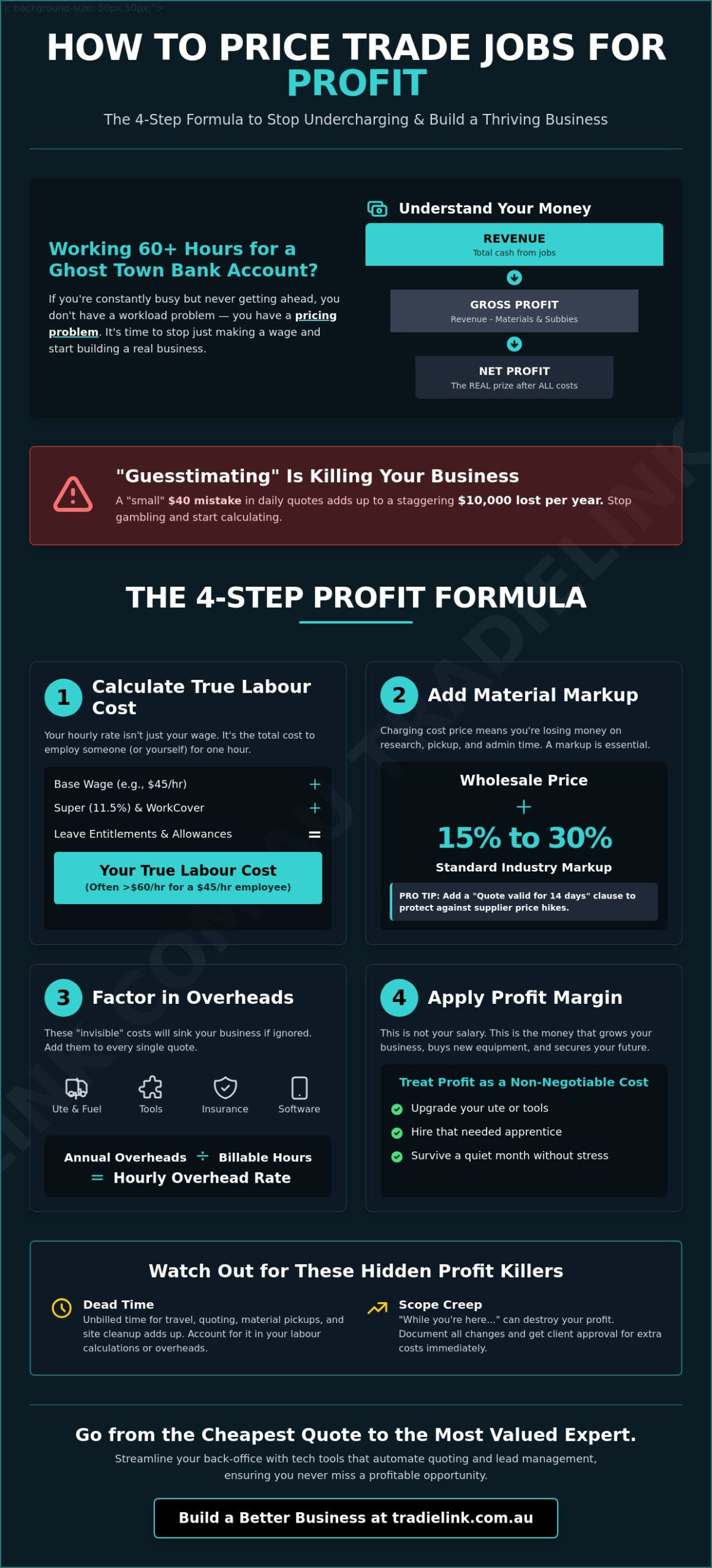
Understanding these three numbers is the difference between a thriving trade business and a closing down sale. Revenue is the total cash that hits your bank account. It looks great on a screen, but it’s deceptive. Gross profit is what’s left after you pay for the materials and the subcontractors on that specific site. Net profit is the final prize. It’s what remains after the ATO takes their cut, your insurance is paid, and the tool shop bill is settled. In 2023, Australian insolvency rates rose by 25 percent, often because owners confused high revenue with actual profit. You must track these three metrics separately in your accounting software to see the true health of your operations.
Why ‘Guesstimating’ is Killing Your Tradie Business
Quoting from the driver’s seat of your Hilux after a five-minute walk-around is a gamble you’ll eventually lose. Small errors in material estimates don’t stay small. A A$40 mistake on a daily fix adds up to A$10,000 over a standard 250-day work year. You can’t afford that leak in your finances. When you guess, you’re usually underestimating the “hidden” time spent on travel, merchant fees, or waste disposal. The Break-Even Point is the exact dollar amount your business must generate to cover all expenses without making a single cent in profit. Knowing this number is the foundation of learning how to price trade jobs for profit because it sets your absolute floor. Stop guessing and start calculating to protect your margins.
The 4-Step Formula for Profitable Quoting
Quoting isn’t just picking a number that feels right or matching the bloke down the road. It’s a precise calculation. To master how to price trade jobs for profit, you need a repeatable system that accounts for every cent leaving your bank account before you even think about your take-home pay. This formula ensures your business grows while you’re on-site doing the work.
Calculating Your True Labour Cost
Your labour rate isn’t just the hourly figure you’d like to earn. It must include the 11.5% Superannuation Guarantee, WorkCover premiums, and leave entitlements. For an employee on A$45 per hour, the actual cost to your business often exceeds A$60 per hour once these “on-costs” are added. Don’t forget to pay yourself a fair market wage first. If you’d pay a subbie A$70 an hour to replace you, that’s your base labour cost. When quoting jobs with a mix of staff, use a weighted average or line-item each person to ensure an apprentice’s lower rate doesn’t accidentally dilute your senior’s higher cost.
Materials and the Power of Markup
Charging exactly what you paid at the wholesaler is a fast track to a cash flow crisis. You spend time researching parts, driving to pick them up, and managing the admin. A consistent markup covers this “hidden” time. Industry standards usually sit between 15% and 30% depending on the item’s value. In a volatile market where timber or copper prices can jump 10% in a single month, always include a “valid for 14 days” clause on your quotes. This protects your margins from supplier price hikes that happen after you’ve sent the proposal.
Don’t Forget the Overheads
Overheads are the “invisible” costs that eat your profit if you ignore them. This list includes your ute’s fuel, tool replacements, public liability insurance, and trade software fees. To find your “hourly overhead rate”, divide your total annual business expenses by your total billable hours. If your overheads are A$45,000 and you bill 1,500 hours a year, you must add A$30 to every hour quoted just to break even. Skipping this step is why many businesses struggle to stay afloat despite being constantly busy.
The final step is applying the Net Profit Margin. This is the “reward” for the business owner and is separate from your wage. Aim for a minimum of 10% to 20% on top of all other costs. This provides a buffer for mistakes and funds for future expansion. Learning how to price trade jobs for profit means knowing the difference between just “buying yourself a job” and actually running a company. Using a digital quoting platform makes these calculations automatic, so you can send professional bids in minutes instead of hours.
The Hidden Profit Killers: Dead Time and Scope Creep
You can have the best tools and the fastest team, but if you don’t account for the hours spent off the tools, your margins will vanish. Many tradies focus solely on the time spent swinging a hammer or pulling cables. They forget that the business keeps running even when the van is parked. Mastering how to price trade jobs for profit requires a brutal look at where your time actually goes. If you aren’t tracking the gaps between jobs, you’re essentially paying to work.
Managing Your Billable vs. Non-Billable Hours
Dead time is the non-billable portion of your day. This includes morning runs to the wholesalers, sitting in traffic on the M1 or the Monash, quoting new jobs, and organizing the back of the ute. These hours aren’t free time; they’re business costs. To stay profitable, you must track every minute. If you bill 30 hours, they must cover 40 hours of work. This ensures your on-site rate accounts for the admin and travel that keeps the business alive. Adjust your hourly rate by dividing your total weekly costs by your actual billable hours, not the total hours you’re awake.
Eliminating Scope Creep Before it Starts
Scope creep is the silent thief of fixed-price jobs. It usually starts with a simple phrase: “While you’re here, could you just look at this?” It sounds small, but these requests eat your profit margin one quick favor at a time. You need a process to handle these moments without losing the client’s goodwill. Clear boundaries are the only way to protect your bottom line when learning how to price trade jobs for profit.
- Use Written Variations: Every change to the original quote needs a written and signed-off price update. Don’t touch the extra work until the digital signature is in your inbox.
- Set Clear Boundaries: Your initial quote should explicitly state what is included and, more importantly, what is excluded. If you’re installing a vanity, state that wall repairs or painting aren’t part of the price.
- Ditch the Mates Rates: Working for friends at a discount is often the fastest way to lose money. If your business overheads sit at 30%, giving a 20% discount means you’re barely breaking even before you’ve even paid yourself.
Clear Terms and Conditions (T&Cs) aren’t just legal fluff. They’re your professional boundaries in writing. Include them in every quote to protect your cash flow and ensure you get paid for every minute you spend on a job site. When you value your time, your clients will too. Professionalism starts with a quote that leaves no room for “guessing” what the final bill will look like.
How to Win High-Profit Jobs Without Competing on Price
Competing on price is a race to the bottom where nobody wins. When you’re the cheapest option, you usually attract the most difficult clients. These customers value every cent over every second of quality. Industry data shows that 85% of Australian homeowners prioritize reliability and professional reputation over the absolute lowest quote. If you want to master how to price trade jobs for profit, you must shift toward value-based pricing. This means charging for the specific problem you solve, not just the hours you spend on-site.
A burst pipe at 2:00 AM isn’t just a plumbing task; it’s a potential A$10,000 flooring disaster. Your price should reflect the risk you’re mitigating and the peace of mind you provide. High-profit tradies use their expertise as a pricing shield. They don’t justify their rates by listing every individual screw and washer on an invoice. Instead, they justify them by demonstrating they’re the safest, most competent pair of hands for the project.
Building a Brand that Commands Premium Rates
Your digital footprint tells a story before you even pick up the phone. A professional website and a detailed TradieLink profile separate you from the “cowboys” who operate out of a messy glovebox. First impressions carry significant weight in the Australian market. Evidence suggests customers are often willing to pay a 20% premium for a contractor who communicates clearly, uses professional digital business cards, and maintains a clean online presence. It builds the trust required to charge what you’re actually worth.
Qualifying Leads to Avoid Tyre-Kickers
Stop wasting three or four hours every week on “check-quotes” for people who only want a bargain. High-profit businesses use their online profiles to pre-educate clients. By showcasing your specific process and high-end finishes, you filter out the bargain-hunters before you ever leave the workshop. Focus your marketing on quality-seekers who understand that a cheap job often costs twice as much to fix later. Use your profile to highlight social proof and recent reviews. This turns your business into a premium service rather than a basic commodity. You’ll spend less time quoting and more time winning profitable work.
Ready to level up your professional image and attract better clients? Join TradieLink today and start building a business that commands top dollar.
Streamlining Your Business for Long-Term Profitability
Pricing for profit isn’t a “set and forget” task. If you only look at your numbers when your accountant calls in July, you’re flying blind. Successful Aussie tradies review their profit and loss statements every month. This habit ensures you spot rising material costs or shrinking margins before they tank your cash flow. You spent four years learning your trade; now you must invest in your business education. Understanding a balance sheet is just as vital as knowing how to wire a switchboard or rough-in a bathroom.
To hit your financial goals, set a clear Profit Target for June 2026. If you want a net profit of A$150,000 after all expenses and your own salary, work backward. Divide that target by your average 1,200 billable hours per year. That calculation shows you need to clear an extra A$125 per hour in pure profit. This level of clarity changes how you look at every quote and ensures you never undersell your expertise again.
- Automate your admin: Use software to handle quoting and invoicing so you aren’t stuck at the kitchen table until 10 PM.
- Review material costs: Check supplier prices quarterly. A 5% increase in copper or timber prices can eat your entire margin if you don’t adjust your rates.
- Track billable vs. non-billable hours: If you spend 15 hours a week driving or doing paperwork, your hourly rate needs to cover that “lost” time.
Leveraging TradieLink for Better Business Management
Data wins arguments and grows businesses. Use the TradieLink dashboard to see exactly where your work comes from. If 70% of your high-margin jobs come from a specific service area, double down there. Stop wasting time on leads that don’t convert. Your profile acts as a digital capability statement. Upload your ABN, insurance, and trade licenses to build instant trust with homeowners. This professional edge allows you to command premium rates because you’ve proven you’re a legitimate, high-quality operator. When you spend less time chasing low-value leads, you can focus on the jobs that actually move the needle.
The Long Game: Building a Sellable Asset
Most tradies don’t have a business. They have a job where they happen to own the tools. To build a sellable asset, you must move from “Sole Trader” to “Business Owner” through systems. A business that relies entirely on you being on-site is only worth the value of the van and the drills. However, a business with documented processes and a clear strategy for how to price trade jobs for profit is an investment. If you want to exit the industry in five or ten years, start acting like a CEO today. Review your rates right now. Value your time like a professional and stop competing on price alone. Your future self will thank you for the margins you protect today.
Take Control of Your Margins Today
Knowing how to price trade jobs for profit is the difference between just getting by and building a legacy. You’ve now got the 4-step formula to protect your bottom line and the strategies to kill off scope creep before it drains your bank account. Data from the ATO small business benchmarks shows that many Australian trade businesses operate on net profit margins between 10% and 15%, meaning there’s zero room for guesswork in your quotes. You can’t afford to leave your earnings to chance when every hour of dead time eats into your take-home pay.
Winning the best jobs isn’t about being the cheapest sparky, plumber, or chippie on the block. It’s about showing up as the most professional option. When you present yourself as an expert, you stop competing on price and start winning on value. Stop the administrative headache and focus on the work that actually pays. Build a professional profile that wins high-profit jobs with TradieLink. We provide the no-nonsense lead management tools and professional digital business cards used by trades across Australia to stay ahead of the pack. It’s your business; it’s time you started making it work for you.
Frequently Asked Questions
How much net profit should a tradie aim for on a standard job?
Aim for a net profit margin between 10% and 20% after paying your own salary and all business overheads. Many Australian trade businesses struggle because they confuse gross profit with net profit. If your business earns A$200,000 annually, a 15% net profit leaves you with A$30,000 for reinvestment. This buffer protects your cash flow and ensures you actually build wealth while learning how to price trade jobs for profit.
What is a reasonable markup for materials in the Australian trade industry?
A standard markup for materials in the Australian trade industry typically ranges from 15% to 30%. This isn’t just extra profit; it covers your time spent sourcing parts, fuel for the trip to the wholesaler, and the risk of holding stock. For smaller items like consumables, markups often reach 50% to account for handling. Always check your merchant invoices to ensure your margins stay consistent as supplier costs rise.
How do I tell a long-term client that I am raising my prices?
Tell your long-term clients about price increases by providing at least 30 days of written notice. Be direct and link the change to rising operational costs or inflation, which sat at 4.1% in late 2023. Most loyal customers understand that quality service requires sustainable pricing. Send a professional email or text explaining that your new rates apply to all work booked after a specific date to keep things transparent.
Should I charge a call-out fee or include it in my hourly rate?
Charge a separate call-out fee to cover your travel time, fuel, and initial assessment. This fee ensures you don’t lose money on short jobs that take 15 minutes but require an hour of driving. In major cities, a standard call-out fee often equals your first hour of labor. It keeps your hourly rate competitive while protecting your bottom line from the “just a quick look” trap.
How do I calculate my hourly charge-out rate from scratch?
Calculate your rate by adding your desired annual salary, total business overheads, and a 15% profit margin. Divide this total by your actual billable hours, not just a standard 40 hour week. Most tradies only bill about 1,200 to 1,500 hours per year after accounting for admin, travel, and holidays. If your total costs are A$120,000 and you bill 1,200 hours, you must charge at least A$100 per hour.
What is the best way to handle ‘mates rates’ without losing money?
Handle “mates rates” by offering a maximum discount of 10% on labor only, never on materials. You should never work for a price that doesn’t cover your overheads and insurance. If a friend can’t pay a fair price, they aren’t supporting your business. A clear policy prevents awkward conversations and ensures you know how to price trade jobs for profit without losing money on jobs for friends or family.
Is it better to provide a fixed quote or an hourly estimate?
Use fixed quotes for well defined projects where you can accurately predict the workload. This gives the client certainty and allows you to earn more if you work efficiently. Switch to an hourly estimate for renovations or repair work where hidden issues like faulty wiring or rot are likely. Always include a 10% to 15% contingency fee in your fixed quotes to handle minor surprises without needing to renegotiate the entire contract.