
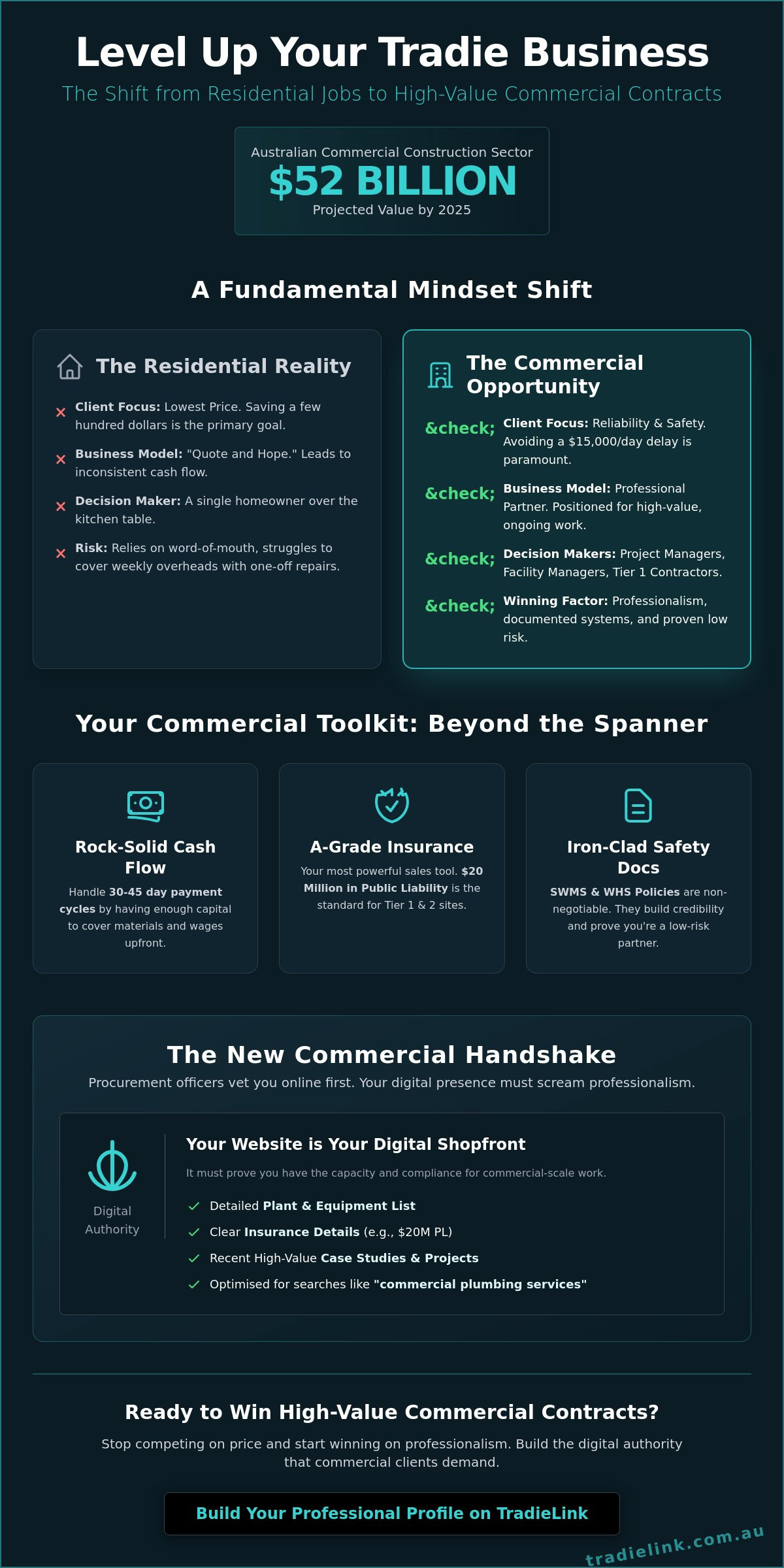
Why are you still relying on word-of-mouth for small domestic jobs when the Australian commercial construction sector is projected to hit $52 billion in value by 2025? Most Aussie tradies feel the grind of inconsistent cash flow and the stress of one-off residential repairs that barely cover the weekly overheads. You know your work is top-notch, but figuring out how to get commercial building contracts often feels like trying to crack a secret code. According to 2023 industry data, many small trade businesses miss out on growth because they don’t have the professional systems required for high-level tenders.
We’ll show you the exact steps to transition from domestic work to high-value commercial projects by building professional authority and reliable systems. You will learn how to move away from the “quote and hope” mentality and start positioning your business as a reliable partner for property managers and Tier 1 contractors. This guide breaks down where to find active tenders, how to impress decision-makers with your documentation, and the specific operational tweaks you need to win. It’s time to stop competing on price and start winning on professionalism.
Key Takeaways
- Shift your focus from the lowest price to demonstrating the reliability and safety standards that high-value commercial clients demand.
- Upgrade your digital presence beyond social media to create a professional “commercial handshake” that proves your business authority.
- Discover how to get commercial building contracts by mastering the Capability Statement, your business’s professional resume for the commercial sector.
- Build strategic “warm” relationships with Tier 2 contractors and decision-makers to access high-value projects before they hit the open market.
- Learn to navigate the complex world of Request for Tender (RFT) documents to ensure your quotes meet strict commercial compliance and criteria.
Commercial vs. Residential: Shifting Your Mindset for Bigger Contracts
Transitioning from residential renovations to commercial sites is a major step for any Australian trade business. The commercial landscape is broad, covering industrial warehouses, retail fit-outs, government infrastructure, and large-scale residential developments. Understanding how to get commercial building contracts starts with realizing that these clients don’t shop like homeowners. A residential client might choose the cheapest quote to save A$500. A commercial project manager will choose the tradie who guarantees they won’t cause a A$15,000-a-day site delay. Speed and certainty win every time.
Reliability and safety are your primary currencies in this sector. Commercial clients operate on razor-thin margins and strict delivery schedules. They expect you to handle your own cash flow, as payment cycles often stretch to 30 or 45 days after the end of the month. You need enough capital to cover materials and wages before that first progress claim lands. Your insurance policies and safety protocols aren’t just administrative hurdles; they’re your most powerful sales tools. If you can’t prove you’re a low-risk partner, you won’t get past the initial vetting process.
The Key Players in Commercial Procurement
You’re no longer dealing with a single decision-maker over a kitchen table. In the commercial world, you’ll answer to Facility Managers, Project Managers, and Tier 1 Contractors. These professionals manage multi-million dollar assets and are hyper-focused on risk mitigation. When they review different construction contracts, they’re looking for a subcontractor who understands the legal and operational demands of the job. You might also need to coordinate with specialist firms like ML Traffic Engineers Australia to ensure site logistics and traffic requirements are met. Procurement officers evaluate your business based on your track record and your capacity to scale. While “who you know” remains vital in the Australian industry, your reputation for finishing on time keeps you on the preferred tenderer list.
Compliance and Safety as a Competitive Advantage
In the commercial space, your paperwork is as important as your physical craft. Safe Work Method Statements (SWMS) and Work Health and Safety (WHS) policies are non-negotiable requirements. Having these documents organized and professional before your first meeting builds immediate credibility. It shows you’re ready for the intensity of a Tier 1 site. You’re shifting from just “getting the job done” to “documenting exactly how the job is done safely.” This level of detail reduces the liability for the head contractor, making you a safe bet. If you want to know how to get commercial building contracts, start by mastering your compliance. It proves your business is ready for the big leagues.
Building Digital Authority: The New “Commercial Handshake”
A handshake on a job site still matters, but it isn’t the first point of contact anymore. Most procurement officers and project managers vet your business online before they even pick up the phone. Relying on a Facebook page suggests you’re a residential side-hustler rather than a serious commercial partner. To understand how to get commercial building contracts, you need a digital presence that screams professionalism and scale.
A centralized professional profile proves your business is active, compliant, and ready for work. Commercial buyers look for specific markers of legitimacy, such as ISO certifications or a history of successfully completed $100,000+ projects. Moving your contact details into the digital age is also vital. Digital business cards are quickly replacing paper versions because they ensure your details land directly in a project manager’s smartphone contact list. This prevents your information from ending up in the bin at the end of a site walk.
The Essential Tradie Website
Your website is your digital shopfront. For commercial work, it needs more than just a gallery of photos. It must include a detailed plant and equipment list to prove you have the gear to handle the workload. List your insurance details clearly, specifically mentioning Public Liability coverage of A$20 million, which is the standard baseline for most Tier 1 and Tier 2 sites in Australia. Use case studies from 2023 and 2024 to show recent wins and high-quality finishes.
Optimise your site for specific search terms like “commercial plumbing services” or “civil earthworks specialists” to capture intent-based searches from builders looking for new subcontractors. Integrating a lead management tool ensures that when a high-value enquiry hits your inbox, you respond within the hour. Speed is a massive competitive advantage when you are learning how to get commercial building contracts in a crowded market.
Leveraging Professional Directories
A high-quality directory profile acts as a secondary layer of verification for commercial buyers. When a head contractor sees your business listed on a professional trade platform, it validates the information found on your website. Consistency is the goal. Your branding, contact numbers, and project history must match across every platform to build trust. If you want to scale effectively, read more about building a professional trade business in 2026. Keeping your details sharp and updated across a trusted trade network makes you the easy choice for the next big tender.
The Essential Documentation: Capability Statements and Prequalification
Landing a big commercial gig isn’t about a handshake and a verbal quote anymore. You need a Capability Statement. Think of this document as your business’s professional resume. It proves you have the gear, the crew, and the financial stability to handle a A$500,000 fit-out or a multi-million dollar warehouse build. Without it, you won’t even make the short list for serious tenders.
Your Capability Statement should be a concise, high-impact PDF that lives on your website and in your email outbox. To make it effective, include these core elements:
- Company Profile: A brief history of your business and your core values.
- Key Personnel: CVs or bios of your site foremen and project managers to show technical expertise.
- Core Competencies: A specific list of services you provide, such as structural steel, commercial plumbing, or electrical fit-outs.
- Major Equipment: A list of plant and machinery you own or have guaranteed access to.
- Safety and Compliance: Your current insurance levels, WH&S policies, and any safety awards.
Social proof is the final piece of the puzzle. Collect testimonials from previous commercial facility managers or developers. A quote stating you “maintained a zero-incident site over a 12-month contract” carries more weight than any sales pitch. This level of detail is vital when you are learning how to get commercial building contracts in a competitive market.
Drafting a Winning Capability Statement
Visual professionalism is non-negotiable. Don’t use blurry phone photos from a messy job site. Invest in high-resolution photography of your best 2023 and 2024 projects. If you hold specific certifications like ISO 9001 for quality or CM3 for prequalification, place those logos on the front page. Use a “Problem-Solution-Result” format for your case studies. For example, explain how you managed a 400sqm retail renovation within a live shopping centre environment without disrupting neighbouring tenancies. This shows you understand the operational risks of commercial work.
Prequalification Portals and Industry Bodies
Large corporate players and government departments use gatekeepers to filter out unreliable contractors. Register your business on portals like Tenders.gov.au or state-specific sites such as Buy NSW or QTenders. Many Tier 1 builders also use third-party platforms like Pegasus or Felix to manage their supply chains. Joining the Master Builders Association (MBA) or the Housing Industry Association (HIA) adds a layer of credibility that 78% of commercial procurement officers look for during screening. Keep your digital folders updated with your latest public liability certificates and licenses. When a tender opens, you need to be ready to submit your documentation instantly, not spend three days chasing your insurance broker for a certificate of currency.
Strategic Networking: Finding Where the High-Value Work Lives
Cold calling is a grind that rarely pays off in the commercial sector. Successful tradies know that learning how to get commercial building contracts requires building “warm” relationships before a tender even hits the desk. You want to be the first person an Estimator thinks of when a project kicks off. Focus your energy on Tier 2 contractors. These firms typically handle projects valued between A$10 million and A$50 million. They are large enough to have consistent work but small enough to value reliable, local partners who don’t bring the overhead of a national firm.
LinkedIn is your most powerful tool for this. Don’t just “connect” with everyone. Target Procurement Officers and Estimators at specific firms. Send a direct, professional message. Mention a recent project they completed and explain how your specific trade could have streamlined their last site handover. It’s about showing you understand their pain points, like site delays or poor communication from subbies.
- Identify Tier 2 targets: Research companies winning mid-scale government or private infrastructure jobs.
- Connect with intent: Follow their company pages to see when they win new tenders.
- Engage with content: Comment on their project updates with technical insights to build authority.
Tapping into the Maintenance Market
Maintenance contracts are the “Holy Grail” of consistent commercial revenue. While one-off builds are great, a 36-month service agreement with a shopping centre manager or a school district board keeps your cash flow steady during industry lulls. To win these, you must move beyond just fixing things. Provide “Value-Add” reports. Use digital asset tracking to show a facility manager that 15% of their HVAC units are likely to fail within the next six months based on wear patterns. When you provide data, you aren’t just a tradie; you’re a strategic partner helping them manage their A$100,000+ annual maintenance budgets.
The Art of the “Follow-Up”
The commercial sales cycle is long. You might quote a job in January that doesn’t start until September. This is where most tradies fail. They send a quote and wait. Research shows that 80% of commercial sales require five follow-up contacts, yet 44% of contractors give up after just one. Use a simple lead management system to track every touchpoint. Your second touch is often where the contract is won. Keep it professional. A quick email asking if the project timelines have shifted shows you’re organized and ready to hit the ground running. Project managers value this level of proactive communication because it suggests you’ll be just as professional once you’re on-site.
Ready to stop chasing leads and start winning high-value work? Join TradieLink today to connect with the right commercial partners and grow your business.
Mastering the Bid: Quoting and Tendering for Commercial Success
Residential quotes are often simple, one-page documents. Commercial tenders are different animals. When you’re learning how to get commercial building contracts, you’ll encounter the Request for Tender (RFT). This document outlines every technical, financial, and safety requirement. Treat it like a legal checklist. If the RFT asks for three years of audited financials or a specific public liability insurance limit, provide exactly that. Missing one detail sends your bid straight to the bin.
Pricing for profit in the commercial sector requires a sharper pencil. You aren’t just charging for materials and labour. You must account for mandatory site inductions, which can eat up four hours before a tool even touches the ground. Compliance costs, including safety audits and detailed reporting, often add 10% to 15% to your overhead. Commercial timelines are rigid. Delays can trigger liquidated damages, potentially costing your business A$500 to A$2,000 per day depending on the project scale.
Professional delivery is non-negotiable. Forget handwritten notes or messy emails. Your final proposal should be a clean, digital package. Use professional estimating software to ensure your figures are accurate. A digital bid shows the head contractor you have the tech-savviness to handle their reporting requirements.
Avoiding Common Tendering Mistakes
A single missing signature or an expired trade license can disqualify your bid instantly. Estimators at large firms review dozens of submissions. They look for reasons to prune the pile quickly. Under-quoting is the most dangerous trap. Winning a A$200,000 contract that actually costs A$210,000 to execute will sink your business. Keep your quote itemised and transparent. This makes it easy for a busy estimator to see you’ve covered the full scope of work.
Closing the Deal and Onboarding
Winning the bid is just the start. You’ll move into the contract phase, where you must review terms like payment cycles and retention sums. Utilizing a secure document signing platform helps manage these workflows and integrated payments securely. Your business systems need to be ready for increased reporting. You’ll likely need to provide weekly progress claims and updated Safe Work Method Statements (SWMS). Set these systems up early to avoid a bottleneck. This is the final step in how to get commercial building contracts and turning them into long-term partnerships.
Ready to Secure Your Next Big Commercial Project?
Moving from residential work to high-value commercial sites requires a professional shift. Success depends on your ability to produce solid capability statements and navigate the tendering process with precision. It’s about proving your reliability and safety standards before you even pick up a tool. When you combine local networking with a sharp digital profile, you position your business as a top-tier contender for lucrative private and government tenders.
Mastering how to get commercial building contracts means building a digital presence that acts as your 24/7 advocate. You’ve got to be where the project managers are looking. TradieLink is here to make that transition seamless. We’re an Australian-owned and operated platform used by thousands of tradies to manage leads and professionalise their digital presence. Our NFC business cards help you make an instant impression on-site, ensuring your credentials land directly in a site manager’s phone with one tap. It’s time to ditch the administrative headache and focus on winning the work you deserve.
Build the professional profile you need to win commercial work with TradieLink
The Australian commercial building industry is growing and it’s waiting for contractors who show up prepared. Take the first step today and watch your business scale to new heights.
Frequently Asked Questions
What is the most important document needed for commercial contracts?
Your Capability Statement is the most critical document for winning commercial contracts. It serves as your professional CV, proving you have the technical skills and financial backing to deliver. Data from the Australian Construction Industry Forum (ACIF) shows that 90% of successful commercial tenders include a detailed breakdown of past project performance. Keep it sharp and highlight your specific certifications to build immediate trust with head contractors.
How do I find commercial tenders in Australia?
You can find commercial opportunities on government portals like AusTender or state-specific sites like NSW eTendering. For private work, platforms like Cordell Connect or EstimateOne list thousands of active projects. Learning how to get commercial building contracts involves monitoring these sites daily for new listings. Statistics from the Australian Government indicate that over 800 commercial building tenders are published monthly across various state and federal procurement systems.
Do I need a special license for commercial building work?
Yes, you need a specific commercial builder’s license issued by your state regulator, such as the QBCC in Queensland or Fair Trading in NSW. These licenses often require higher financial backing than residential ones. For example, a Category 1 contractor in Queensland must prove a Minimum Net Tangible Asset (NTA) of A$156,000 to maintain their license. Check your local state requirements to ensure your business structure meets the specific commercial grading.
Is it worth hiring a consultant to write my capability statement?
Hiring a professional consultant is often worth the investment if it secures a single high-value contract. A well-structured statement can increase tender success rates by 25% according to industry benchmarks. Consultants ensure your document meets the strict formatting and compliance standards required by Tier 1 and Tier 2 firms. If your current document isn’t converting leads into site visits, a professional refresh provides the competitive edge you need.
How payment terms differ in commercial building contracts?
Commercial contracts typically use longer payment cycles and include retention sums, often 5% of the total contract value. Unlike residential jobs where you might get a deposit, commercial work relies on progress claims under the Security of Payment Act 1999 (NSW) or equivalent state laws. Expect 30-day payment terms from the date of your invoice. Managing your cash flow is vital because you’ll often fund materials and labor weeks before receiving payment.
Can a sole trader win a commercial contract?
A sole trader can win commercial work, particularly as a specialist subcontractor or for maintenance contracts under A$50,000. Winning large head contracts is difficult as a sole trader due to the high insurance and financial capacity requirements. Many Tier 1 builders require subcontractors to be PTY LTD companies for risk management purposes. Focus on building relationships with larger firms to get your foot in the door as a trusted specialist.
What insurance do I need for commercial projects?
You need Public Liability insurance with a minimum cover of A$20 million for most Australian commercial sites. You’ll also require Workers Compensation for all staff and often Professional Indemnity insurance if you’re involved in the design phase. Contract Works insurance is another standard requirement that protects the project from fire, storm, or theft. Always provide your certificates of currency with your initial quote to show you’re ready for the job.
How can I compete with larger companies for the same tender?
Compete with larger firms by highlighting your niche expertise and lower overhead costs. Smaller outfits can often move faster and provide more direct communication with the project manager. When researching how to get commercial building contracts, emphasize your hands-on approach and specialized crew. Data shows that 40% of developers prefer smaller, agile teams for specialized fit-outs because they offer better quality control than massive, multi-layered corporations.