

Imagine you just finished a high-pressure emergency repair in Melbourne. The client is impressed and asks for your details. You reach into your work gear, but your last paper business card is a damp, illegible mess of ink and cardboard. It’s a common on-site disaster that kills repeat business. Traditional business cards printing often fails the “pocket test” before the lunch break even hits. When 88% of paper business cards are thrown away within a week according to Adobe research, you’re literally tossing your marketing budget into the skip bin.
You know that a professional first impression is the difference between a one-off job and a lifelong client. We’ve been in the trenches and understand that your contact info needs to be as tough as your tools. This guide compares traditional card stock against the latest 2026 digital alternatives to find the most durable, cost-effective way to secure your next lead. We’ll break down the ROI of NFC technology versus bulk-buy gloss finish, ensuring you never lose a job because a client lost your number.
Key Takeaways
- Stop losing leads to flimsy cards by selecting the right GSM and “tradie-proof” finishes during your next business cards printing run.
- Uncover the hidden costs of paper re-orders and how a single NFC investment can save your business hundreds in A$ over the long term.
- Apply the “Three-Second Rule” to your design to ensure potential clients can contact you instantly without fumbling for details.
- See why modern tradies are ditching paper for digital profiles that stay updated in real-time and work as hard as you do on-site.
- Compare the durability and professional impact of 350gsm stock against the high-tech connectivity of TradieLink’s NFC-enabled solutions.
The Evolution of Business Cards Printing for Australian Tradies
Modern business cards printing in 2026 goes far beyond putting ink on paper. It’s about creating a physical touchpoint that survives the harsh conditions of an Australian job site. Your card is often the first tangible piece of your business a client touches. A flimsy, poorly printed card kills your credibility before you’ve even pulled out your tools. It signals a lack of attention to detail that clients will assume extends to your trade work.
While the history of business cards dates back to 15th-century China, the 2026 Aussie version has evolved into a high-performance tool. It’s no longer just a glovebox essential for emergencies. It’s an active networking asset. High-quality finishes and durable materials now define the standard for professional tradies from Perth to Brisbane. Your choice of card reflects the quality of your craft, so settling for the cheapest option often costs you more in lost leads.
Why a Professional Card Still Wins Jobs
Trust is the currency of the trade industry. When a site manager or a homeowner sees a crisp, well-designed card, they see a legitimate, registered business. It builds immediate confidence. The “referral hand-off” is where physical cards truly shine. When a happy client says, “I know a great plumber,” handing over a physical card is more effective than telling them to search for a name on social media. It makes the recommendation frictionless. A professional card establishes your brand identity as a reliable partner, not just another bloke with a ute and a ladder.
The Limitations of Traditional Paper Cards
Standard paper cards often fail the “ute test.” Mud, grease, and water destroy 300gsm cardstock in seconds. If your contact info is unreadable because of a coffee stain or a bit of grit, you’ve lost the job. Statistics show that roughly 88% of paper business cards are thrown away within a week. This “lost in the drawer” syndrome is a major hurdle for growth. Traditional cards also suffer from being static. If you change your mobile number or expand your services, you’re stuck with a box of useless paper. You need a solution that bridges the gap between a physical handshake and a digital connection. For a detailed breakdown of why traditional cards are failing on-site and what modern alternatives offer, see our business cards for tradies 2026 comparison and strategy guide.
- Durability: Paper fails in high-moisture environments like bathrooms or outdoor sites.
- Waste: Re-printing costs add up when business details evolve.
- Engagement: Traditional cards offer no way to track who is actually calling you from the card.
Choosing the right business cards printing method is about more than just aesthetics. It’s about ensuring your first impression lasts longer than the drive to your next job.
Evaluating Printing Options: Stocks, Finishes, and Durability
A flimsy business card suggests a flimsy job. When you hand a card to a potential client on-site, that piece of cardstock represents your reputation. Professional business cards printing needs to account for the harsh conditions of a toolbox, a dashboard, or a crowded wallet. You need materials that don’t just look good when they leave the box but stay sharp after a week in your pocket.
Choosing the Right Paper Weight (GSM)
Grams per Square Metre (GSM) determines the thickness and “heft” of your card. In the Australian market, 350gsm is the absolute minimum for a professional feel. Anything lighter feels like a cheap flyer and will likely end up in the bin. If you want to project a high-end image, 450gsm is the gold standard. It’s significantly stiffer and provides a premium feel that suggests your craftsmanship is worth the extra investment.
- 350gsm: The budget-friendly choice for high-volume networking. It’s reliable but can feel standard.
- 450gsm+: The “heavyweight” option. It resists bending and feels substantial in a client’s hand.
- Plastic and Synthetic: For plumbers, pool techs, and landscapers, 100% waterproof synthetic stocks are a game changer. These cards won’t turn to pulp if they get wet on a job site.
Protective Coatings That Last
The secret to “tradie-proof” cards is the finish. Uncoated cards soak up oil and dirt from your hands instantly. Celloglaze is a thin laminate film applied to the card that provides a protective barrier. Matt celloglaze offers a smooth, sophisticated look that is easy to read under bright site lights. Gloss celloglaze makes your brand colours pop but can be prone to fingerprints.
If you keep your cards in a tool bag, ask for anti-scuff laminate. This specific finish prevents the “rubbing” effect where cards scratch each other while sitting in the box. While choosing your finish, remember to consider what your card must include to remain functional. For example, if you often write quotes or dates on the back of your card, leave the reverse side uncoated. You can’t write on a laminated surface with a standard pen.
Survival Features and Premium Touches
Standard square corners are the first thing to dog-ear and peel. Rounded corners are a practical choice for tradies because they slide into wallets without catching. They stay looking fresh for months longer than square-cut cards. If you want to stand out from the local competition, consider specialty finishes like Spot UV or raised ink. These techniques add a 3D texture to your logo, making it memorable through touch. It’s an effective way to level up your professional image while you’re out quoting on new projects. High-quality business cards printing is a small upfront cost that prevents your contact details from becoming unreadable litter.
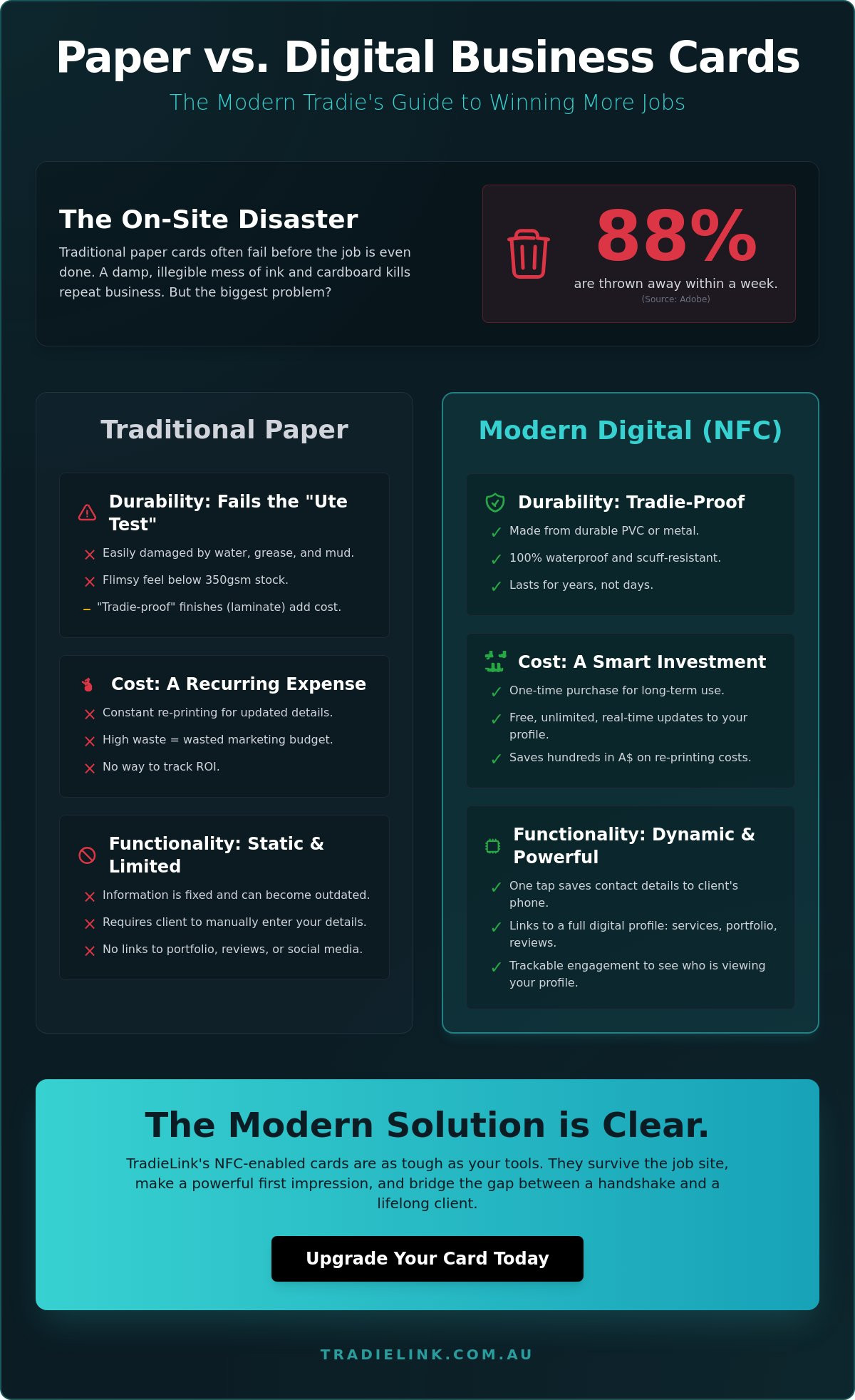
Paper Printing vs. Digital Business Cards: A Commercial Comparison
Traditional business cards printing remains a staple for the Australian construction industry, but the hidden costs are biting into tradie margins. When you opt for paper, you aren’t just paying for the ink. You’re paying for professional design fees that can range from A$50 to A$150, shipping costs around A$15 per order, and the inevitable waste when you change your phone number or upgrade your trade license. If your details change, those 500 cards in your glovebox become instant landfill.
Digital NFC cards represent the one-time investment standard for 2026. For a single payment, usually between A$40 and A$90, you get a card that lasts for years. The sustainability factor is a massive win for your brand image. Reducing your business footprint by cutting out thousands of discarded paper slips shows you’re a forward-thinking operator. Statistics from Adobe suggest that 88% of paper business cards are thrown away within seven days. For a tradie, that’s literally throwing leads in the bin.
The ROI of One-Tap Connectivity
NFC stands for Near Field Communication. It’s the same tech you use at the Coles checkout. You tap your digital card against a customer’s smartphone, and your contact profile opens instantly. This removes every bit of friction. Your customer doesn’t have to type your name or number; they just hit ‘save’.
The real commercial edge is the tracking. You can’t see who looked at your paper card after you left the site. With a digital profile, you get hard data. You’ll know exactly how many people tapped your card or clicked your “Request a Quote” link this month. This lets you see which networking events or site visits are actually generating work. For a real-world example of how this digital pipeline transforms a trade business, see how one Aussie sparky scaled their business in 2026 using a streamlined digital presence.
When to Stick with Paper Printing
Paper still has its place in a tradie’s toolkit, especially for mass-drop marketing. If you’re hitting a new housing estate with a letterbox drop, cheap business cards printing is the most cost-effective way to get your name into 500 homes quickly. You don’t want to leave an expensive NFC card under a windshield wiper.
You also need to cater to the “no-tech” client. While 90% of Australians own a smartphone, some older demographics still prefer the physical hand-off of a card they can pin to a corkboard. The smartest move for 2026 is a hybrid strategy. Carry a small stack of high-quality paper cards that feature a prominent QR code. This gives the client a physical object while allowing them to scan your details digitally if they choose. It bridges the gap between the old school and the new age without missing a single lead.
Designing for Leads: What Your Card Must Include
You have three seconds before a potential client decides to keep your card or bin it. This is the “Three-Second Rule” of effective business cards printing. If a homeowner has to squint to figure out if you’re a sparky or a chippie, you’ve already lost the lead. Your primary service must dominate the visual hierarchy. Use a bold, sans-serif font for your trade specialty, making it at least 50% larger than your business name.
The layout should guide the eye from the service to the contact method. Don’t clutter the front with every job you’ve ever done. Stick to one or two core services. If you try to say everything, you end up saying nothing. White space isn’t wasted space; it’s what makes your phone number stand out when someone’s looking for it in a dark meter box or a cluttered kitchen drawer.
Essential Information Checklist
Modern business cards printing for the Australian market requires more than just a name and number. You’re competing with dozens of other local businesses, so authority is your biggest asset. Ensure your card includes:
- Clear Business Name: Use the name that matches your vehicle signage.
- Trade Specialty: Be specific, such as “Licensed Gas Fitter” or “Structural Landscaper”.
- License Numbers: Displaying your QBCC or NSW Fair Trading license number is often a legal requirement and an instant trust builder.
- Insurance Logos: A small icon indicating you’re fully insured for public liability reduces the perceived risk for the client.
- Single Call to Action (CTA): Use a direct command like “Call for a Quote” or “Text for Emergency Repair”.
Bridging the Physical-Digital Gap
Your card is the handshake, but your digital presence closes the deal. Use a dynamic QR code on the back of the card. Unlike static codes, dynamic ones allow you to update the destination URL without reprinting your entire batch. Point this code directly to your tradies australia profile where clients can view verified reviews and photos of your recent projects. Data from 2025 shows that tradies using QR codes on physical marketing see a 22% increase in website traffic compared to those who don’t.
Every card needs a Unique Selling Proposition (USP) that tells the client why they should pick you over the bloke down the road. For the front of your card, use a single, punchy sentence: “We guarantee a 60-minute response time for all emergency call-outs in the Western Suburbs or the first hour of labour is free.”
Don’t leave the back of the card blank. It’s prime real estate. Use it for a “Next Service Due” calendar for HVAC techs, a “Safety Checklist” for electricians, or a list of five-star testimonials. This adds value to the card, making it a tool the client wants to keep rather than a piece of paper they feel okay throwing away.
The Modern Solution: TradieLink Digital Business Cards
Traditional business cards printing often feels like a gamble. You buy a box of 500 cards, but three months later you change your mobile plan or add a new service, and that entire stack becomes landfill. TradieLink has moved beyond the limitations of static paper. We provide a high-tech alternative that combines a physical card with a live, cloud-based profile. This means you only ever need one card. It’s a permanent tool in your kit that evolves alongside your business.
The real power lies in the automatic updates. When you change your details in the TradieLink app, the information linked to your card updates instantly. You don’t have to worry about clients calling an old number or seeing an outdated list of services. It’s about efficiency and making sure you never miss a lead because of a typo or a change in your business structure. We’ve integrated this hardware directly with your lead management system, turning a simple introduction into a data-driven growth strategy.
How the TradieLink NFC Card Works
The technology is straightforward and built for speed. Each card contains a Near Field Communication (NFC) chip. When you’re on-site or meeting a potential client, they simply tap their phone against your card. Your professional profile opens immediately on their screen. There’s no app for the customer to download and no clunky QR codes to scan in low light. It works seamlessly on almost all modern smartphones released after 2018.
- Durable Construction: These aren’t flimsy bits of cardboard. Our cards are made from hardened materials designed to survive the Australian trade lifestyle. They handle dust, moisture, and the general chaos of a work ute without breaking.
- Instant Connection: One tap saves your contact info, website, and social links directly to the client’s phone.
- Professional Finish: The card looks and feels like a premium tool, reflecting the quality of the work you do.
Connecting Your Card to Your Growth Strategy
In the current market, 80% of customers prefer digital contact methods over physical filing. By using a digital card, you’re driving traffic directly to your custom tradie website where they can see your previous projects and reviews. This isn’t just about handing out a number; it’s about capturing lead data the moment you meet someone. Every tap is an opportunity to move a prospect into your quoting pipeline without manual data entry.
If you’re still relying on old-school business cards printing, you’re leaving your professional image to chance. Switch to a system that works as hard as you do. Order your NFC Digital Business Card today and start building a more connected, professional trade business that’s ready for 2026 and beyond.
Future-Proof Your Trade Business with Smarter Connectivity
Traditional business cards printing often leads to wasted cash and missed opportunities on the job site. While premium card stocks might look decent, they don’t solve the core problem of a potential client losing your contact details before they even get home. Thousands of Aussie tradies nationwide have already made the switch to digital solutions to ensure they never miss a lead again. By moving beyond paper, you’re not just handing out a name; you’re building a professional bridge that works as hard as you do.
Modern trade businesses require tools that keep pace with a busy schedule. You need a system that integrates your contact details directly into a customer’s phone with zero fumbling. TradieLink provides that edge, offering an instant connection that feeds into a complete lead management ecosystem designed for professional growth. It’s about working smarter, not harder, and ensuring your business stays visible long after you’ve left the site. Take control of your professional identity and start closing more jobs today. We’re here to help you build something that lasts.
Ditch the paper and upgrade to an NFC Digital Business Card
Frequently Asked Questions
Is business cards printing still worth it for tradies in 2026?
Yes, business cards printing remains a vital tool for Australian tradies because it bridges the gap between a physical handshake and a digital lead. Research from 2025 indicates that 72 percent of people judge a company’s quality by the feel of their business card. A physical card ensures your contact details stay on a client’s fridge or desk where they won’t get lost in a crowded digital inbox or a deleted text thread.
What is the best paper weight (GSM) for a tradesman business card?
You should choose a minimum of 450gsm for a professional and durable finish. While 350gsm is the industry standard for budget cards, it feels flimsy and cheap to the touch. A 450gsm premium card stock provides the weight and rigidity needed to survive in a work ute or pocket. It sends a clear signal that your business is established, reliable, and focused on high-quality results rather than cutting corners.
How much does it cost to print 500 business cards in Australia?
Expect to pay between A$65 and A$120 for 500 standard business cards from reputable Australian suppliers in 2026. If you opt for premium features like spot UV, raised foil, or recycled stocks, the price often increases to approximately A$180. Investing in professional business cards printing ensures your first impression isn’t ruined by thin paper or blurry text that might suggest your workmanship is similarly sub-par.
Can I put a QR code on my printed business cards?
You definitely should include a QR code to make it easier for clients to find your digital profile. Data from early 2026 shows that 45 percent of customers prefer scanning a code over manually typing a website URL or phone number. This allows a homeowner to instantly view your latest projects, check your current licensing status, or book a quote directly from their smartphone without any friction or data entry errors.
What is an NFC digital business card and how does it work?
An NFC card uses Near Field Communication technology to transfer your contact info with a single tap against a client’s phone. It contains a tiny chip that triggers a link to your digital profile or VCF file. While 80 percent of tradies still rely on paper, these reusable cards are a smart backup. You only need to carry one card, which makes it a sustainable and tech-forward way to manage your connectivity on-site.
Should I choose matt or gloss finish for my trade business cards?
Choose a matt laminate or a scuff-resistant finish for the best longevity on a job site. Gloss finishes tend to show every fingerprint, smudge, and scratch, which looks unprofessional after five minutes in a pocket. Matt finishes offer a sophisticated look and are much easier to read under bright outdoor sunlight. If you want a bit of flair, add a spot UV gloss only to your logo for a high-contrast effect.
What information is legally required on a tradie business card?
You must include your full name, registered business name, and your trade licence number to comply with Australian state regulations like the NSW Home Building Act 1989. Failing to display your licence number can result in fines exceeding A$750 in some jurisdictions. Always include your ABN and clear contact details. This transparency builds immediate trust with new clients and ensures you meet all local advertising requirements for licensed contractors.
How do I stop my business cards from getting ruined on-site?
Switch to 100 percent waterproof synthetic stocks or plastic cards if you work in wet or dusty environments. These materials are tear-proof and you can easily wipe them clean if they get covered in grease or mud. If you prefer traditional paper, keep your stack in a hard metal case instead of a loose wallet. A simple A$15 card holder prevents bent corners and ensures every card you hand out looks brand new.